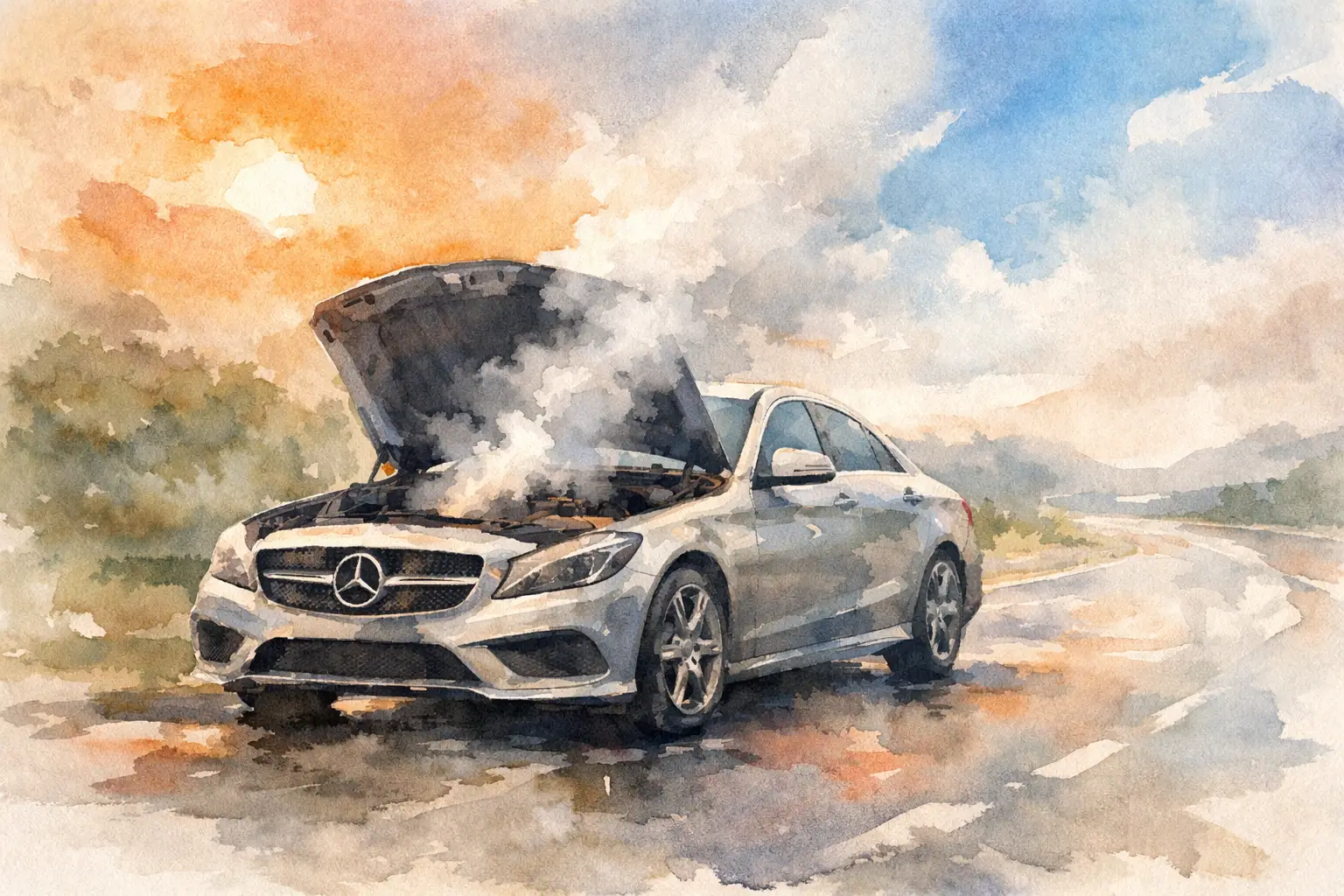
A Mercedes that suddenly shows a high coolant temperature warning, sends steam from under the hood, or turns the cabin heat cold needs attention immediately. If you are asking, “why is my Mercedes overheating,” the safest answer is not to keep driving until you reach home or work. Pull over when it is safe, turn the engine off, and allow it to cool. A modern Mercedes-Benz engine can suffer expensive damage quickly when coolant temperature rises beyond its normal operating range.
What to Do When Your Mercedes Overheats
If a red coolant warning appears, the temperature gauge climbs into the hot range, or you smell sweet coolant, reduce load on the engine and find a safe place to stop. Turn off the air conditioning, which reduces demand on the cooling system. Do not open the coolant expansion tank while the engine is hot. Pressurized coolant can spray out and cause serious burns.
Once the vehicle has fully cooled, look beneath it for obvious coolant puddles and check whether the coolant level in the expansion tank is low. This can provide useful information, but it does not identify the cause. Adding coolant may get the level back up, yet it will not repair a leak, failed water pump, stuck thermostat, or inoperative cooling fan.
If the warning was red, if steam was visible, or if the engine was running rough, arrange for towing rather than driving the vehicle further. The cost of a tow is minor compared with the risk of warped cylinder heads, damaged head gaskets, or internal engine damage.
Why Is My Mercedes Overheating? Common Causes
Mercedes cooling systems are engineered for precise temperature control. That is good for efficiency, emissions, and performance, but it also means one weak component can affect the entire system. The root cause depends on the model, engine, mileage, service history, and the conditions in which the temperature rises.
Coolant Leaks
Low coolant is one of the most common reasons for overheating. Leaks can develop at radiator hoses, plastic fittings, expansion tanks, radiator end tanks, thermostat housings, heater components, water pumps, or seals. On some Mercedes models, a small leak may only appear when the system is hot and pressurized, leaving little or no evidence on the driveway.
Coolant residue can look white, pink, blue, or crusty depending on the approved coolant used and the age of the leak. A trained technician can pressure-test the system to locate leaks that are not visible during a quick inspection.
A Failing Water Pump
The water pump circulates coolant through the engine, radiator, heater core, and other cooling passages. If the pump leaks, its impeller fails, or its drive system has a problem, coolant may not move fast enough to control engine temperature.
Some pumps provide warning signs, such as a coolant leak near the front of the engine, bearing noise, or a temperature rise that becomes worse under acceleration. Others fail with little warning. Mercedes engines should be diagnosed by model-specific procedures because pump design and access vary considerably between engine families.
A Stuck Thermostat
The thermostat regulates coolant flow to the radiator. When it sticks closed or does not open fully, heat remains trapped in the engine. A thermostat problem can cause the temperature to climb quickly after warm-up, particularly during highway driving or under load.
A thermostat that is electronically controlled may also set fault codes. Reading those codes is useful, but codes alone do not prove the thermostat is the only issue. Coolant level, circulation, sensor readings, and fan operation should be checked before replacing parts.
Electric Cooling Fan or Fan Control Faults
Many Mercedes-Benz vehicles rely on high-capacity electric fans. These fans are especially critical in Silicon Valley traffic, during hot weather, and when the air conditioning is operating. If the fan motor, fuse, wiring, control module, or temperature input fails, the vehicle may run normally at freeway speed but overheat while idling or moving slowly.
A fan concern is not always obvious from the driver’s seat. The fan may run intermittently, operate at the wrong speed, or fail only once the engine reaches a certain temperature. Proper diagnostics confirm whether the command signal and actual fan response match.
A Restricted Radiator or Airflow Problem
The radiator must transfer heat out of the coolant, and airflow through the front of the vehicle matters just as much as coolant circulation. Internal radiator restrictions can reduce cooling capacity, particularly on higher-mileage vehicles or systems that have been contaminated with incorrect coolant. External debris between the radiator and air-conditioning condenser can also limit airflow.
This issue can show up during long climbs, heavy traffic, hot days, towing, or spirited driving. AMG models, SUVs, and Sprinters often work harder under these conditions, so a cooling system that seems adequate during an easy commute may reveal a weakness when demand increases.
A Pressure Cap, Sensor, or Electrical Issue
The expansion tank cap helps maintain cooling-system pressure. A weak cap can allow coolant to boil at a lower temperature or escape from the system. Temperature sensors, wiring concerns, and communication faults can also trigger warnings or provide inaccurate readings.
That said, a warning should never be dismissed as “just a sensor” until the mechanical cooling system has been evaluated. A scan tool may reveal the reported temperature, but a complete diagnosis compares live data with actual system behavior.
Internal Engine Problems
Less commonly, overheating is caused by combustion gases entering the cooling system through a failed head gasket, cracked cylinder head, or another internal fault. Symptoms may include repeated coolant loss without an external leak, bubbles in the expansion tank, white exhaust smoke, oil contamination, misfires, or pressure building rapidly in the cooling system.
These concerns require careful testing. Replacing visible cooling components without confirming the source can waste money and delay the right repair.
When the Overheating Happens Can Point to the Problem
The driving condition matters. If your Mercedes gets hot mainly while idling, the cooling fan, airflow, or low coolant level deserves close attention. If it overheats at highway speeds, coolant circulation, thermostat operation, radiator capacity, or a significant leak may be more likely.
If the temperature rises only when climbing hills, carrying passengers or cargo, towing, or accelerating hard, the system may be marginal under load. If the heater suddenly blows cold while the temperature rises, coolant may be low or air may be trapped in the system. These patterns help narrow the diagnosis, but they are not a substitute for testing.
Why Mercedes-Specific Diagnostics Matter
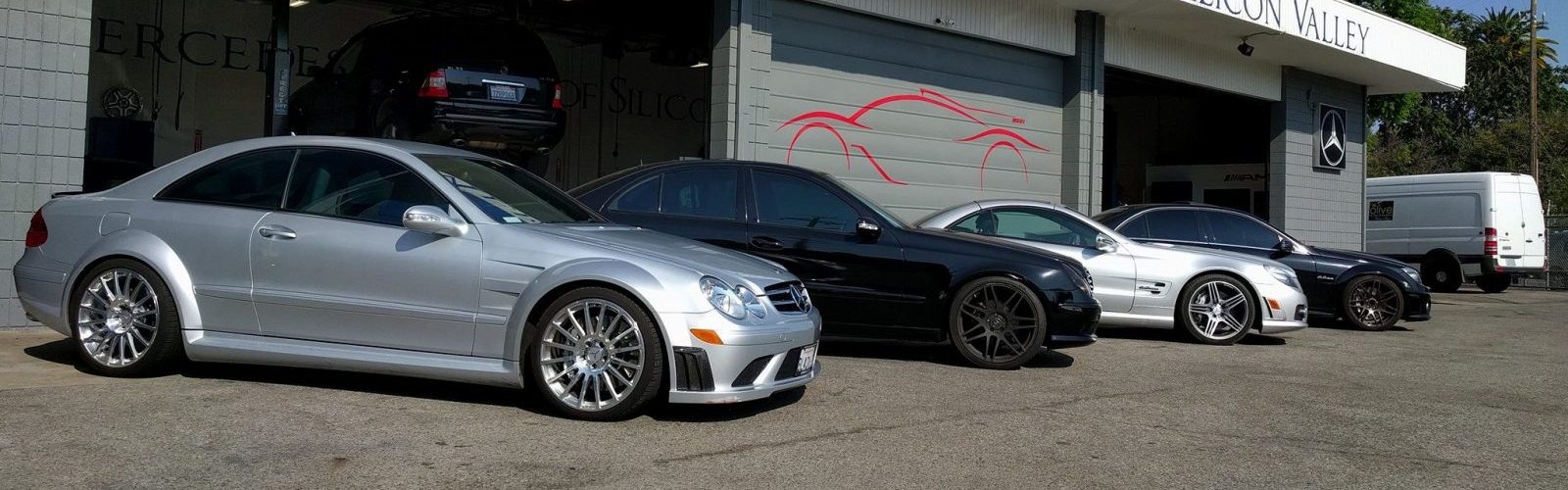
A Mercedes cooling-system repair should begin with evidence, not guesswork. At Mercedes Service of Silicon Valley, diagnosis can include a visual inspection, cooling-system pressure test, verification of coolant condition and level, electric fan testing, live temperature data review, and fault-code analysis using Mercedes-capable diagnostic equipment.
The goal is to identify the failed component and understand why it failed. For example, a coolant leak may have caused air pockets that affect temperature readings. A thermostat fault may exist alongside a weak water pump. A radiator replacement may be unnecessary if the true issue is a fan control fault. Transparent testing protects the vehicle and helps avoid replacing parts that do not solve the problem.
Using OEM-quality parts and the correct Mercedes-approved coolant is equally important. Mixing incompatible coolant types or using an incorrect concentration can reduce corrosion protection and compromise cooling performance over time.
Can You Drive a Mercedes With a High Temperature Warning?
It depends on the severity, but a red warning, steam, coolant loss, or a gauge in the hot zone means do not continue driving. Even a brief overheating event can create damage that is not immediately apparent. If the warning clears after the car cools, schedule an inspection promptly rather than assuming the issue resolved itself.
For a mild temperature increase with no warning, avoid heavy acceleration, towing, or extended idling until the vehicle can be checked. Monitor the gauge closely and stop immediately if the temperature continues to rise. Do not rely on repeated coolant top-offs as a long-term solution.
Your Mercedes is designed to deliver confident performance, but its cooling system needs the same level of attention as its engine, brakes, and transmission. Treat an overheating warning as an early chance to protect the vehicle, then have the cause confirmed before a manageable repair becomes an engine repair.