
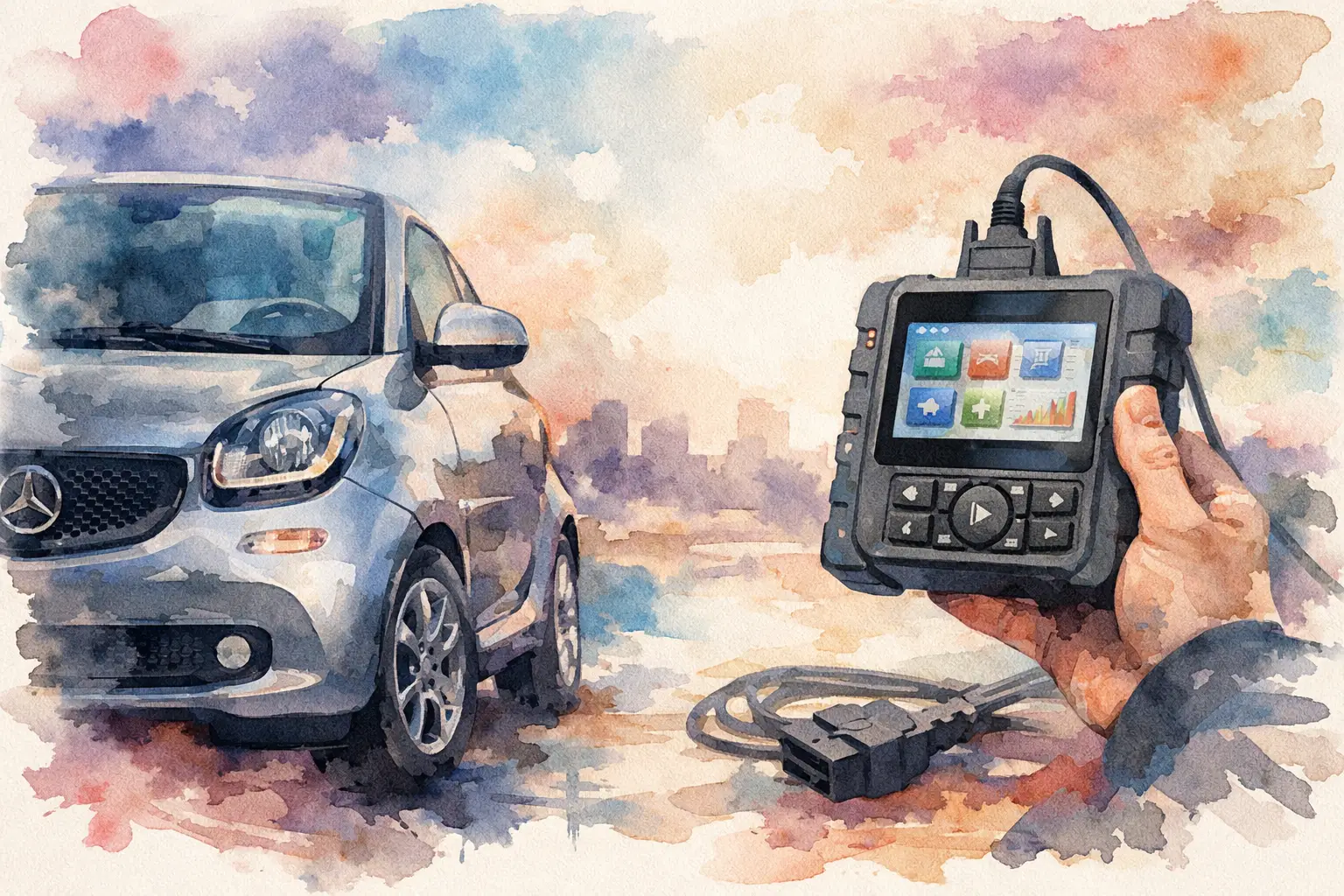
A warning light on a Mercedes-Benz rarely tells the whole story. The same check-engine light that a universal code reader identifies as a sensor issue may be connected to wiring, fuel-trim data, a module communication fault, or a calibration concern. This Mercedes scan tool review looks past marketing claims to explain what different diagnostic tools can actually do, where they fall short, and when professional testing is the smarter investment.
What a Mercedes Scan Tool Must Do Well
Mercedes-Benz vehicles are built around a network of specialized control modules. Depending on the model and equipment, a vehicle may have separate modules for the engine, transmission, ABS, air suspension, steering, climate control, seat systems, radar sensors, cameras, infotainment, and safety restraints. Reading a generic engine code is useful, but it is only one small part of the diagnostic picture.
A worthwhile Mercedes scan tool should communicate with more than the engine control unit. It should read manufacturer-specific fault codes, display live data, identify vehicle information accurately, and access systems beyond standard emissions diagnostics. On newer vehicles, it also needs to handle complex module networks without losing communication or presenting vague, misleading descriptions.
The difference matters when a customer is deciding whether a repair is truly necessary. A code is not a diagnosis. It is a clue that must be interpreted alongside freeze-frame data, current measurements, service history, known Mercedes fault patterns, and a physical inspection.
Mercedes Scan Tool Review: The Three Main Categories
The best tool depends on what you need from it. An owner checking a warning light has different needs than a technician repairing an intermittent electrical fault on an AMG, a late-model SUV, or a Sprinter.
Basic OBD-II Readers and Phone Apps
Basic Bluetooth adapters and code readers are affordable, convenient, and often useful for a first look at a check-engine light. They can retrieve standardized powertrain codes, clear some emissions-related faults, and show simple live information such as coolant temperature, engine RPM, or battery voltage.
Their limitation is access. Most cannot fully communicate with Mercedes-specific systems, retrieve all manufacturer codes, perform actuations, reset service functions correctly, or guide a technician through module programming. They may also translate a code into a generic description that sounds more certain than it is.
For example, a generic reader may point to an oxygen sensor code. That does not automatically mean the sensor has failed. An intake leak, fuel-delivery problem, exhaust leak, wiring issue, or engine misfire can create data that leads to the same code. Clearing it without finding the cause can turn a manageable concern into a repeat failure.
A basic reader is a reasonable glove-box tool for an owner who wants context before scheduling service. It is not a substitute for comprehensive Mercedes diagnostics.
Mercedes-Focused Aftermarket Scan Tools
The next level includes handheld and tablet-based scan tools designed to support Mercedes-Benz models. These tools generally offer deeper module access, more brand-specific code descriptions, maintenance resets, electronic parking brake functions, steering-angle calibration, battery registration, and selected bidirectional tests.
For a knowledgeable independent shop, the right aftermarket platform can be a helpful part of the diagnostic process. For experienced owners, it can also provide useful information about a vehicle’s systems without the limitations of a generic reader.
Still, capability varies significantly by tool, vehicle year, and software subscription. A scanner that works well on an older W204 C-Class may have limited coverage on a newer W206, GLE, EQ model, or vehicle with advanced driver-assistance systems. Some tools advertise coding or programming functions but provide limited instructions, incomplete security access, or no reliable recovery plan if a procedure fails.
This category is often the best value for routine maintenance support, but buyers should verify coverage for their exact Mercedes chassis, model year, and intended function before purchasing. “Mercedes compatible” is not the same as dealer-level access.
Factory-Level Diagnostic Systems
Factory-level diagnostic equipment provides the deepest access to Mercedes-Benz control units, guided test routines, technical information, software updates, and system adaptations. This is the level required for many difficult electrical faults, module replacements, software-related issues, advanced safety-system calibration, and programming work.
It is also where professional judgment matters most. Factory equipment can identify detailed faults and direct a technician through a test plan, but it does not replace hands-on expertise. A technician still needs to understand whether a fault is caused by a damaged connector, a weak battery, a failed component, water intrusion, network communication, or an earlier repair performed incorrectly.
For most owners, purchasing factory-grade equipment is not practical. The cost, subscriptions, training, and risk associated with coding or programming make it better suited to a Mercedes specialist that uses it every day.
Features That Matter More Than a Long Menu
Scan-tool listings can be full of impressive claims. The features that provide real value are the ones that help confirm a repair rather than simply generate more codes.
Look for these capabilities when comparing a Mercedes-specific tool:
- Full-system scanning that reaches chassis, body, transmission, safety, and convenience modules, not just the engine.
- Accurate live data, including values that can be graphed and compared during a road test or under operating conditions.
- Bidirectional controls, sometimes called active tests, that let a user command certain components and verify response.
- Service functions appropriate for the vehicle, such as maintenance resets, battery registration, brake service mode, or steering-angle calibration.
- Current software coverage, clear vehicle compatibility, and a support path when a tool cannot access a module or complete a function.
Bidirectional testing deserves special attention. Being able to command a cooling fan, operate an actuator, cycle an air-suspension component, or test a fuel-system function can help separate a failed part from a wiring or control problem. This is one reason a professional diagnostic process is more reliable than replacing parts based on fault-code descriptions alone.
The Risks of Clearing Codes and DIY Coding
Clearing a warning light can feel like progress, especially if the vehicle appears to drive normally afterward. But clearing faults also removes valuable evidence. Freeze-frame conditions, fault frequency, and module history can help identify an intermittent issue. If the warning returns, the vehicle may be no closer to a real repair.
Coding presents a larger concern. Modern Mercedes-Benz vehicles may require correct software configuration after battery replacement, module replacement, retrofits, or repairs involving driver-assistance systems. An interrupted procedure, incompatible software, or incorrect variant coding can disable features, create new fault messages, or leave a module unable to communicate.
This does not mean owners should avoid every service function. Resetting an oil-service reminder after completing proper maintenance is very different from programming a replacement transmission control unit. The appropriate level of DIY work depends on the system, the tool, and the consequences if something goes wrong.
When Professional Diagnostics Save Money
Professional diagnostics are not simply an added charge before repair. Done properly, they are the work that prevents unnecessary parts replacement. This is especially valuable when a Mercedes has multiple warning messages, intermittent electrical concerns, no-start conditions, air-suspension faults, transmission behavior changes, or driver-assistance alerts.
A skilled Mercedes technician will begin with the customer’s description of the concern, scan every relevant module, inspect the vehicle, evaluate live data, and test the suspected circuit or component. That process takes more time than connecting a scanner, but it produces a recommendation that can be explained and supported.
At Mercedes Service of Silicon Valley, factory-trained experience and genuine diagnostic equipment are used to identify the cause of a concern before recommending repairs. For owners in San Jose and the surrounding Silicon Valley area, that means a clearer answer than “the scanner says you need this part.”
Choosing the Right Diagnostic Path
If you want a scan tool for basic awareness, a quality OBD-II reader can be useful. If you maintain an older Mercedes and understand the systems you are servicing, a well-supported Mercedes-focused tool may offer meaningful convenience. If the vehicle has a persistent warning light, safety-system message, programming need, or unusual drivability issue, factory-level diagnostics and an experienced specialist are the safer choice.
The best scan tool is not necessarily the one with the longest feature list. It is the one that provides dependable information for the job at hand – and is paired with enough Mercedes knowledge to turn that information into the right next step.