
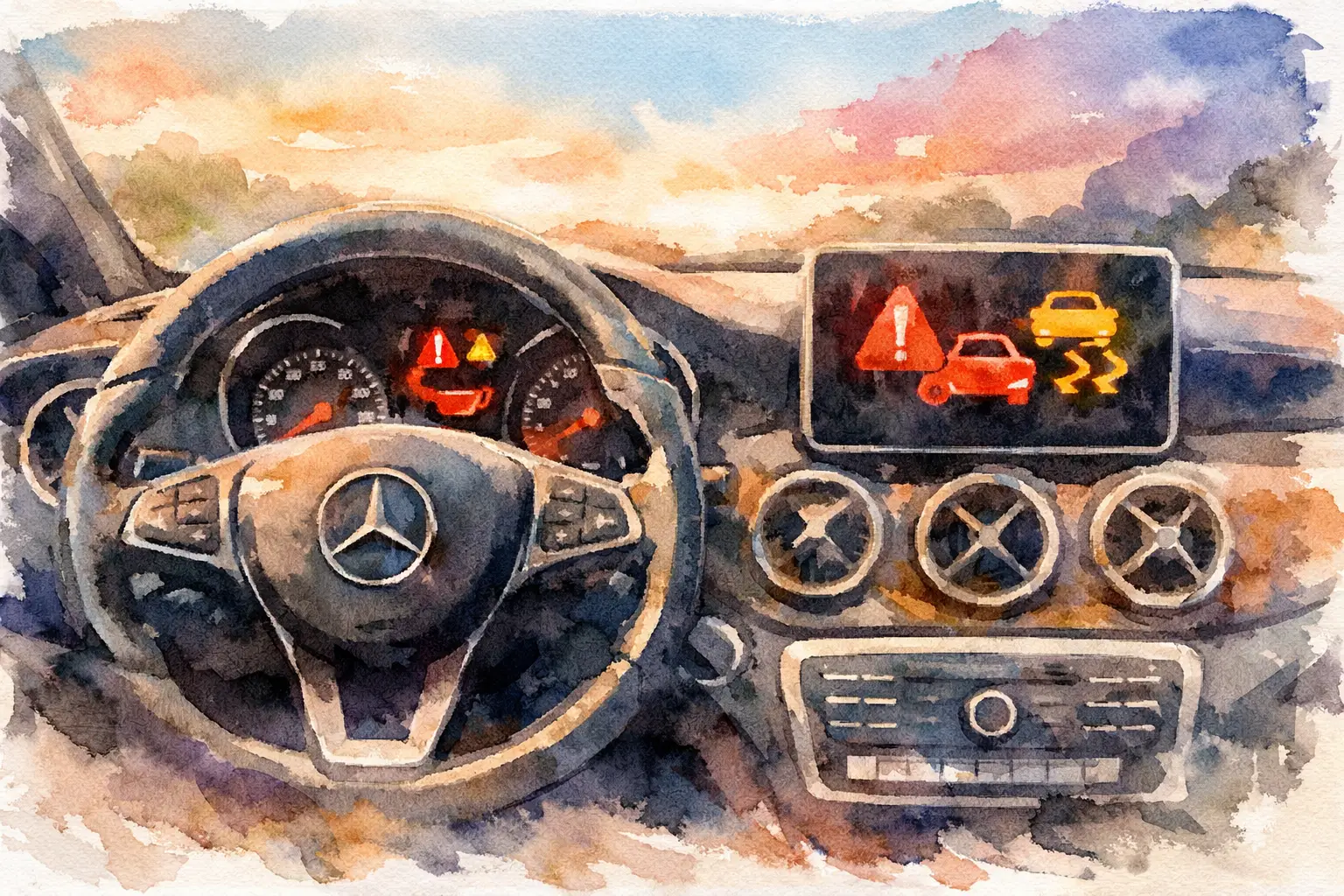
That light came on during your commute, and now you are doing the mental math. Is it safe to keep driving, or are you one mile away from turning a small repair into a major one? A good mercedes dashboard warning guide helps you make that call calmly and correctly.
Mercedes-Benz warning systems are more sophisticated than what you see in many other brands. The dashboard is not just reporting that something feels off. In many cases, it is monitoring a network of control modules, sensors, hydraulic systems, charging output, emissions equipment, and driver-assistance functions in real time. That is why one warning can mean anything from a loose gas cap to a fault that affects braking, engine protection, or air suspension.
How to use this Mercedes dashboard warning guide
The first thing to understand is that color matters. Red warnings usually point to a condition that needs immediate attention. Yellow or amber warnings often mean the vehicle can still be driven, but it should be inspected soon. White and blue indicators are usually informational, though on newer Mercedes models even an informational message can be tied to a system that needs calibration or service.
The second thing is context. A warning light by itself does not always tell the whole story. If the check engine light appears together with reduced power, rough running, or transmission behavior that feels abnormal, the problem becomes more urgent. If a tire pressure warning appears on a cold morning and the car drives normally, you may be dealing with a straightforward pressure adjustment rather than a failed sensor.
Red warnings you should not ignore
A red oil pressure warning is one of the most serious alerts you can see. This is not the same as a maintenance reminder for an oil service. Low oil pressure means the engine may not be getting proper lubrication. Continuing to drive can cause internal engine damage very quickly. If this warning comes on, the safe move is to stop the vehicle as soon as conditions allow and have it evaluated before restarting.
A red coolant temperature warning also deserves immediate attention. Mercedes engines are designed with tight tolerances, and overheating can damage head gaskets, cooling components, and in severe cases the engine itself. Sometimes the cause is simple, such as low coolant from a leak. Other times it is a failing water pump, thermostat, fan issue, or cooling system fault that needs proper diagnosis.
The brake warning light is another one to treat seriously, especially if it appears with a change in pedal feel. On some models it can point to low brake fluid, worn brake components, or a fault within the braking system. If the ABS or stability control light joins it, the vehicle may still stop, but not with the full safety margin Mercedes engineered into the car.
A battery or charging system warning in red is easy to underestimate. Drivers often assume the battery is just old. In reality, the issue may be the alternator, voltage regulation, wiring, or an electrical management problem. On a Mercedes, once charging voltage falls outside the proper range, multiple systems can begin acting strangely. You may notice warning messages stacking up as control units lose stable power.
Amber warnings that still need attention soon
The check engine light is probably the most misunderstood item in any Mercedes dashboard warning guide. It can be triggered by minor emissions faults, but it can also signal problems involving ignition coils, fuel delivery, boost pressure, sensors, or timing-related concerns. If the light is steady and the car drives normally, you usually have time to schedule diagnostics. If it flashes, that is more serious. A flashing check engine light can indicate an active misfire that may damage the catalytic converter.
An ABS warning or ESP warning means a safety system is no longer operating as intended. The vehicle may still be driveable, but anti-lock braking, traction support, or stability intervention could be reduced or unavailable. In wet weather, heavy traffic, or emergency maneuvers, that matters.
A tire pressure monitoring warning should be checked promptly, but it is not always dramatic. Tire pressures naturally shift with temperature. Still, a slow leak, puncture, cracked wheel, or faulty sensor can produce the same light. On heavier Mercedes SUVs and Sprinters, incorrect tire pressure also affects handling and tire wear more than many drivers realize.
Air suspension warnings are common on certain Mercedes platforms as they age. If you see a message related to AIRMATIC, the cause may be a leaking air strut, weak compressor, valve block issue, or ride-height sensor fault. Some owners wait because the vehicle still drives. The trade-off is that a small leak can overwork the compressor and turn a more manageable repair into a more expensive one.
Service reminders versus real fault messages
Mercedes uses both scheduled maintenance reminders and fault-based alerts, and they are not the same thing. A Service A or Service B message is a maintenance countdown based on mileage, time, and model-specific requirements. It does not mean the car is failing. It means the car is due for factory-recommended service.
A warning message tied to engine, brake, battery, suspension, or safety systems is different. That message is usually being triggered by live data or a stored fault in one or more control modules. This is where owners can get tripped up. A generic scan tool might read a simple code, but Mercedes diagnostics often require brand-specific equipment to see the full picture, including manufacturer fault trees, freeze-frame data, and system communication faults.
Why Mercedes warning lights need Mercedes-specific diagnostics
Modern Mercedes vehicles are packed with interconnected systems. An issue in one area can create warning messages in another. A weak auxiliary battery can trigger communication faults. A wheel speed sensor can affect ABS, traction control, adaptive cruise, and collision-prevention systems. Voltage irregularities can create a dashboard full of warnings that look unrelated.
This is why accurate diagnosis matters more than guessing. Replacing parts based only on a generic code description often wastes money. Factory-trained technicians who work on Mercedes daily know the common failure patterns, the software behavior, and the difference between a root cause and a secondary symptom. That is especially important on newer models, AMG vehicles, and diesel or Sprinter platforms where one fault can cascade into multiple messages.
What you can safely check yourself
There are a few situations where a quick owner check makes sense. If you have a tire pressure warning, inspect the tires visually and confirm pressures when the tires are cold. If you have a washer fluid warning, that is straightforward. If a service reminder appears, you can plan around your schedule, though it is still smart not to push it too far.
For most other warnings, caution is the better approach. Do not assume topping off fluids solves the underlying problem. Low coolant means there is a reason coolant is low. Low oil can indicate consumption, a leak, or an issue with maintenance history. Clearing a warning without diagnosing it may remove the message temporarily, but it does not remove the fault.
When to stop driving and call for help
If the vehicle is overheating, losing power suddenly, showing low oil pressure, displaying brake warnings with poor braking feel, or running rough with a flashing check engine light, stop driving. The same goes for severe suspension sag, smoke, burning smells, or major electrical malfunctions. Those are not wait-and-see situations.
If the warning is amber and the car feels normal, you likely have time to get it inspected without panic. Even then, sooner is usually cheaper than later. Many Mercedes faults start small. Catching them early helps protect other systems and keeps repairs more predictable.
For local drivers, this matters during long Bay Area commutes. A warning light that seems minor in your driveway can become a much bigger issue in stop-and-go traffic, summer heat, or on a longer run toward Gilroy or Fremont.
A practical Mercedes dashboard warning guide mindset
The best way to think about warning lights is not fear, and not denial. It is triage. What is the color? How is the car behaving? Is there a change in temperature, power, braking, steering, ride height, or charging? Those clues help separate a manageable service visit from a situation where the car should not be driven.
At Mercedes Service of Silicon Valley, that is how we approach diagnostics every day – no scare tactics, no guessing, and no replacing parts just to see what happens. Mercedes owners deserve answers that are specific, honest, and backed by the right tools.
If your dashboard has started talking to you, listen early. Most of the time, your car is giving you a chance to fix the problem before it gets expensive.