
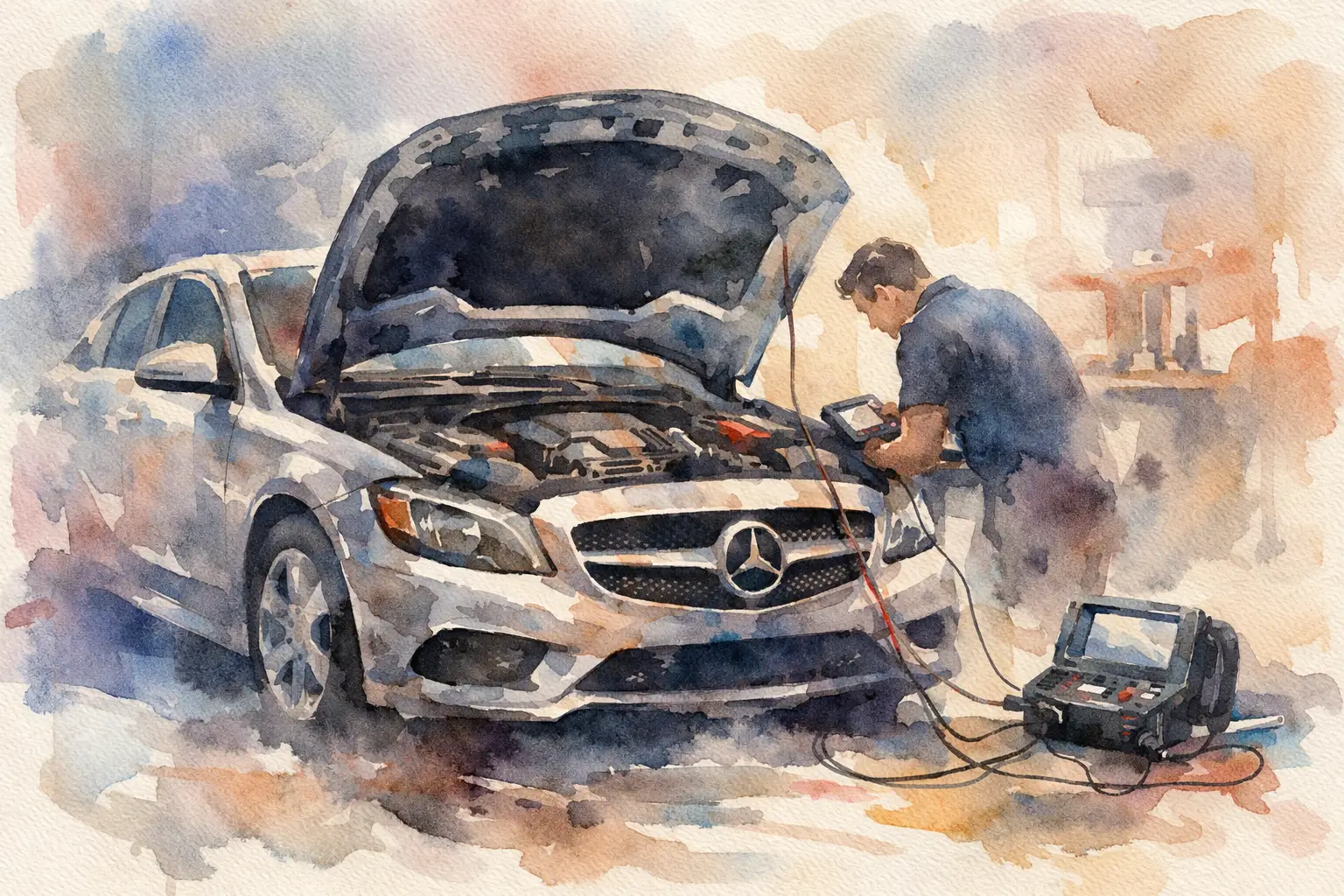
A Mercedes that will not start is rarely a repair that should begin with replacing parts. The dash may light up, the starter may click, or the engine may crank normally without firing, but those symptoms can come from very different systems. This Mercedes no start diagnosis example shows why Mercedes-specific testing matters before anyone recommends a battery, starter, fuel pump, or control module.
For Silicon Valley drivers, a no-start condition is more than an inconvenience. It can mean being late to work, stranded after a school pickup, or unable to use the SUV, Sprinter, or AMG you depend on. The fastest path back on the road is a measured diagnosis that identifies the failed system and confirms the actual cause.
First, Define What “No Start” Means
Technicians separate no-start complaints into two broad groups: no-crank and crank-no-start. A no-crank condition means the engine does not turn over when the driver attempts to start it. There may be a single click, repeated clicking, a message in the instrument cluster, or no response at all.
A crank-no-start condition means the engine rotates, but does not run. It may sound healthy while cranking, start briefly and stall, or crank faster than normal. That distinction changes the diagnostic path immediately. A starter issue can prevent cranking, for example, but it will not explain an engine that cranks strongly and never fires.
Mercedes-Benz vehicles add another layer of complexity because the start authorization system, battery management, electronic ignition switch, transmission selector status, engine electronics, and network communication all play a role. Reading one fault code is not enough. The code must be evaluated alongside live data, voltage readings, and the vehicle’s exact behavior.
Mercedes No Start Diagnosis Example: A No-Crank SUV
Consider a late-model Mercedes SUV that arrives after sitting overnight. The owner reports that the vehicle unlocked normally, the interior lights came on, and the instrument cluster illuminated. When the start button was pressed, however, the vehicle displayed a warning and produced one click. The engine did not crank.
It would be easy to label this a bad battery. In fact, low voltage is common, particularly when a vehicle has short-trip use, an aging battery, a parasitic draw, or a battery that has reached the end of its service life. But the presence of lights and displays does not prove that the battery can support the high current demand required during a start attempt.
The diagnostic process begins with a visual inspection and a properly performed battery test. Technicians check battery state of charge, battery health, terminal condition, ground connections, and voltage drop under load. They also inspect whether the correct battery type and capacity are installed and whether replacement battery information was properly registered in the vehicle when applicable.
In this case, the main battery initially measured adequate resting voltage. During the start request, though, voltage dropped sharply. Factory-level diagnostic equipment also showed intermittent communication faults across multiple control units. That combination pointed toward an electrical supply problem rather than a failed starter or an engine fault.
Further voltage-drop testing found corrosion and high resistance at a primary power connection. The battery itself was not the root cause. Replacing the battery alone might have appeared to solve the problem temporarily, but the poor connection would have continued creating inconsistent voltage delivery. After repairing the connection, confirming stable voltage during crank request, and clearing the related low-voltage faults, the vehicle started normally.
That is the value of diagnosis: the repair addressed the fault, not just the most familiar symptom.
Why a Scan Tool Alone Would Not Have Been Enough
The stored faults in this example were useful, but they did not state, “replace this connection.” Low-voltage faults can appear in the engine control unit, transmission module, body systems, and safety systems because each module reacts when system voltage falls below its operating threshold.
A qualified Mercedes technician uses those faults as evidence, then verifies the evidence with electrical testing. This avoids the expensive mistake of replacing modules simply because they reported communication errors. On modern Mercedes models, one power or ground issue can create a long list of secondary codes.
A Different Path: The Engine Cranks but Will Not Run
Now consider a Mercedes sedan that cranks at normal speed but will not start after refueling. The battery and starter have already done their jobs well enough to rotate the engine. The focus shifts to the conditions an engine needs to run: correct air, fuel delivery, ignition, compression, timing, and valid electronic authorization.
A technician begins by checking for relevant fault codes and live data during cranking. Is the engine speed signal present? Does the engine control unit recognize crankshaft position? Is fuel pressure building to specification? Are injector and ignition commands being issued? Does the vehicle show a start authorization concern? The answers narrow the path quickly.
In one realistic scenario, live data may show that engine speed is present but rail pressure remains below the level required for injection. The cause could be a failing fuel pump, a control issue, a wiring concern, a fuel contamination problem, or a pressure leak. Replacing a high-pressure component before checking actual pressure and command signals would be guesswork.
On the other hand, if fuel pressure is correct but the engine speed signal drops out during cranking, a crankshaft position sensor or its circuit becomes more relevant. If the engine starts briefly and immediately stalls, technicians also consider intake air issues, fuel delivery, immobilizer-related authorization, and model-specific fault patterns. The correct repair depends on test results, not on which part failed on a similar vehicle.
Start Authorization and Key Recognition Issues
Some no-start concerns occur before the engine control unit ever permits cranking. A driver may see a “Key Not Detected” message, have a key that will not turn or be recognized, or experience a start button that does nothing despite a charged battery.
Mercedes start authorization systems are designed to protect the vehicle, but they depend on several components communicating correctly. Depending on model year and configuration, diagnosis may involve the key, electronic ignition switch, steering lock system, antenna components, control-module communication, and battery voltage. A weak key battery can be a simple cause on certain models, but it should not be assumed to be the answer when the vehicle has deeper communication or authorization faults.
This is one area where generic code readers are particularly limited. They may show only broad network faults or fail to access the Mercedes-specific control units needed to see the actual start authorization status. Genuine diagnostic equipment and Mercedes experience make a meaningful difference.
What Owners Should Do Before Calling for Service
If your Mercedes will not start, avoid repeated start attempts. Constant cranking can drain the battery, overheat the starter, and make a straightforward diagnosis harder by adding low-voltage symptoms. If there is a strong fuel smell, smoke, overheating, or a battery warning accompanied by hot electrical components, stop and arrange safe transport rather than attempting a jump-start.
It helps to note what happened immediately before the failure. Was the vehicle driven normally that day? Did it sit for several days? Did a warning message appear? Does it crank, click, or remain completely silent? Was recent work performed, or was a new battery installed? Those details give the technician a stronger starting point.
A jump-start can be appropriate in some situations, but it is not a diagnosis. If the vehicle starts after a jump, the next question is why the battery discharged or why it could not deliver sufficient current. The answer may be an aged battery, charging-system concern, cable resistance, software-related battery management issue, or an electrical draw while parked.
Repair the Cause, Then Verify the Fix
A professional no-start repair does not end when the engine first fires. The technician should confirm reliable starting, verify charging voltage and relevant live data, recheck fault memory, and ensure that the original symptoms do not return. If a low-voltage event produced secondary faults, those systems should be evaluated carefully rather than ignored.
At Mercedes Service of Silicon Valley, that approach is central to the repair process: inspect carefully, test with the right equipment, explain what the vehicle needs, and avoid recommending parts that testing does not support. Whether the issue is a basic battery connection or a complex electronic authorization fault, the goal is the same – restore dependable starting without unnecessary expense.
When a Mercedes will not start, the most helpful next step is not to guess at the part. Preserve the symptoms, share the details, and let a Mercedes-focused diagnostic process turn an uncertain breakdown into a clear repair plan.