
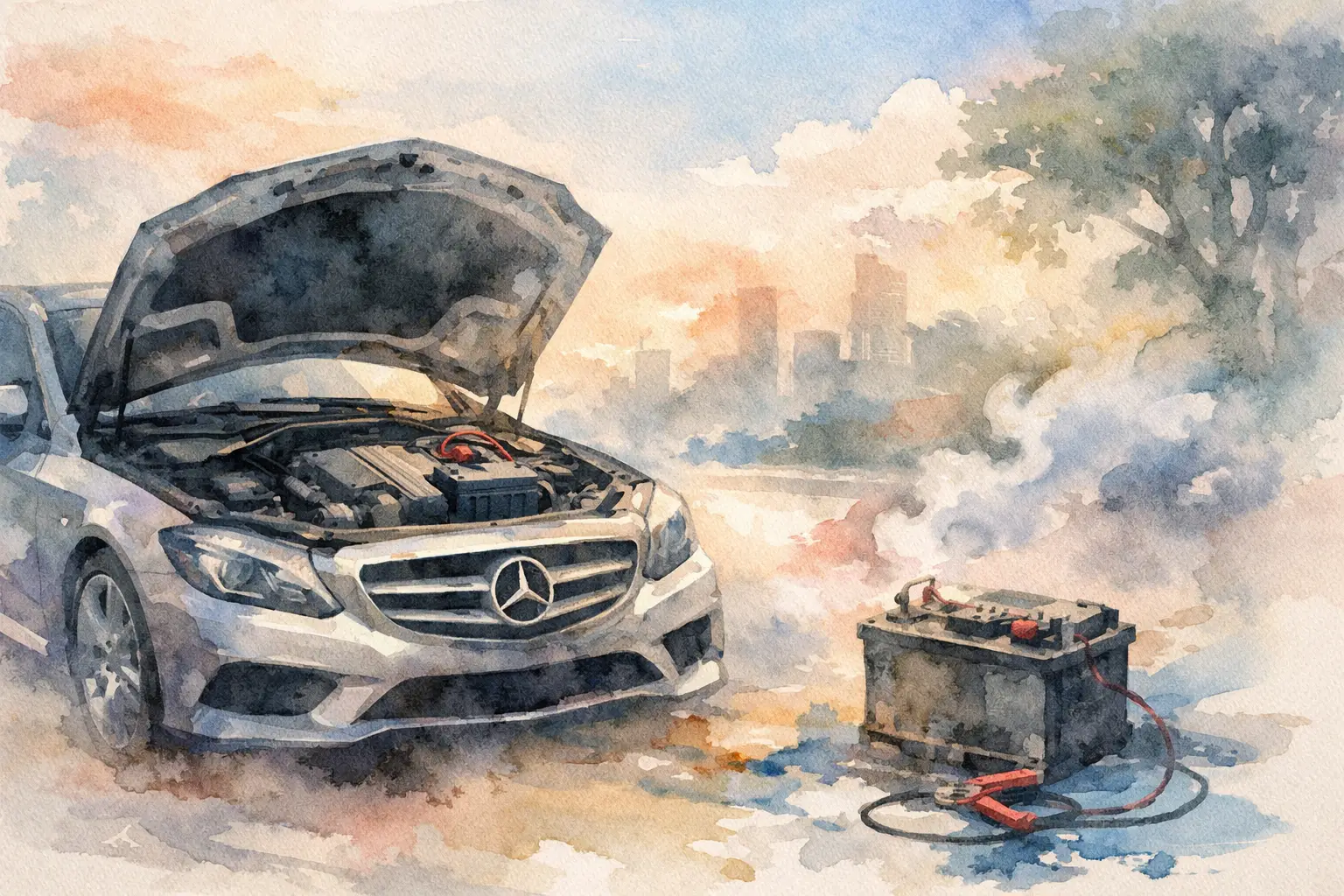
You go out in the morning, press the start button, and your Mercedes barely wakes up – or does not start at all. If you have been asking why does Mercedes battery drain, the short answer is that modern Mercedes-Benz vehicles use complex electrical systems, and when one module, sensor, charging component, or battery itself is not behaving correctly, the battery can discharge faster than it should.
That does not always mean the battery is bad. In many cases, the real issue is hidden elsewhere. Mercedes vehicles are designed with sophisticated control units, comfort features, security systems, and networked electronics. When everything is working properly, a small amount of battery draw while parked is normal. When something stays awake or the charging system falls behind, that normal draw turns into a no-start situation.
Why does Mercedes battery drain when parked?
A Mercedes can lose battery charge while parked for a few different reasons, and the exact cause depends on the model, age, driving habits, and condition of the electrical system. One of the most common situations is excessive parasitic draw. That is the electrical load that continues after the car is shut off.
Every Mercedes has some standby power usage. The alarm, memory functions, keyless entry, and various control modules need a small amount of energy even when the engine is off. Normally, the car enters sleep mode after a set period and the draw drops to an acceptable level. If a module fails to go to sleep, the battery keeps feeding it all night.
This can happen because of a faulty convenience module, an issue in the infotainment system, a malfunctioning trunk latch switch, a telematics unit that stays active, or an aftermarket accessory that was not integrated correctly. We also see charging system concerns that get mistaken for battery drain. If the alternator is weak or the voltage regulator is inconsistent, the battery may never recover fully during normal driving.
Short-trip driving is another big factor in Silicon Valley traffic. If the vehicle is used for quick commutes, school runs, or stop-and-go errands, the battery may not get enough charging time to offset repeated starts and accessory use. Heated seats, HVAC blowers, dash electronics, cameras, and phone charging all add load. Over time, a battery that is only partially recharged starts to act like it is failing, even if the original cause is usage pattern.
The most common causes of Mercedes battery drain
Battery age still matters. Most Mercedes batteries have a finite service life, and once capacity drops, the margin for normal parasitic draw gets smaller. A battery that handled a week of sitting when new may struggle after a few years, especially in vehicles with high electrical demand.
Another common issue is an intelligent battery sensor or battery management problem. Many Mercedes models monitor battery condition closely. If the system is seeing incorrect values or the battery was replaced without proper registration or adaptation when required, charging behavior can be affected. That does not happen on every model in the same way, but on newer Mercedes platforms, battery replacement is often more than a simple swap.
We also see current draw from interior and exterior lighting systems. A glove box light, trunk light, vanity mirror light, or door module that does not shut down completely can drain a battery surprisingly fast. These are easy to miss because the car may look fully off from the outside.
Then there is the alternator itself. People often assume that if the car runs, the alternator must be fine. Not necessarily. An alternator can produce enough output to keep the engine running but still fail to charge the battery correctly under different loads. A diode failure inside the alternator can also create a drain path when the engine is off.
Aftermarket electronics are another frequent culprit. Dash cams, radar detectors, alarm systems, audio amplifiers, and phone chargers can all create battery drain if they are wired to constant power or if they interfere with normal sleep cycles. On a Mercedes, electrical modifications need to be done carefully. These vehicles are not forgiving when it comes to random add-ons and poor wiring practices.
Symptoms that point to more than a weak battery
If the engine cranks slowly once after sitting for several days, an aging battery may be the only issue. But if the battery goes dead repeatedly after being replaced, that usually points to a deeper fault.
You may notice warning messages for low voltage, malfunctioning start-stop operation, erratic power windows, a flickering instrument cluster, or comfort functions acting strangely. In some cases, the car may throw multiple fault codes that seem unrelated. Low system voltage can confuse networked control units and trigger symptoms across several systems at once.
Intermittent no-start conditions are especially common with battery drain complaints. The vehicle may start perfectly for a week, then suddenly have a dead battery after sitting overnight. That pattern often suggests a module waking up unexpectedly or failing to shut down on certain cycles.
This is where proper Mercedes diagnosis matters. Replacing the battery without measuring actual current draw and checking charge performance can turn into guesswork quickly.
Why guessing usually costs more
Battery drain problems are frustrating because the failure does not always happen on command. A quick voltage check at a generic shop may not reveal much if the battery has just been charged. Even a battery test can look decent if the underlying issue is parasitic draw or an intermittent charging fault.
A proper diagnosis involves more than testing whether the battery is dead. The technician needs to evaluate battery health, charging voltage, sleep-mode behavior, and current draw over time. On Mercedes vehicles, that also means understanding how factory systems communicate and what normal sleep patterns look like for that chassis.
The trade-off is simple. A low-cost guess might seem attractive at first, but if the real problem is a control unit, alternator diode, or hidden electrical consumer, you can end up paying for a battery you did not need plus a second repair later. Accurate diagnosis upfront is usually the more cost-conscious path.
What owners can check before scheduling service
There are a few practical things you can pay attention to before bringing the car in. If the vehicle sits for long periods, note how many days it takes before the battery weakens. If it only happens after two or three days, that is different from a battery dying after two weeks.
Also think about how the car is driven. Frequent short trips are hard on modern batteries. If you recently installed any accessory, even something small, mention it. And if lights stay on longer than expected in the trunk, cabin, or mirrors, that is worth noting too.
What you should not do is keep jump-starting the car for weeks and hope it clears up. Repeated deep discharges shorten battery life and can create additional electronic issues. Mercedes control units do not like unstable voltage.
When professional Mercedes diagnosis is the right move
If you are still wondering why does Mercedes battery drain on your specific vehicle, the real answer comes from testing, not assumptions. Mercedes-Benz electrical systems are too model-specific for generic trial-and-error repairs. A proper inspection should include battery testing, charging system analysis, parasitic draw measurement, and a scan of the vehicle’s control modules with Mercedes-capable diagnostic equipment.
That matters even more on newer models with advanced driver assistance systems, multiple networked modules, and battery management strategies that are far more involved than older vehicles. The same is true for AMG models and Sprinters, where electrical demands can be significant.
At a Mercedes-specialized shop, the goal should be to identify the exact source of the drain and recommend only what is needed. Sometimes it is a battery at the end of its life. Sometimes it is a software or module issue. Sometimes it is an alternator that is weak under load. The point is to separate symptom from cause.
For owners in San Jose and the surrounding Silicon Valley area, this is one of those repairs where brand-specific experience saves time. At Mercedes Service of Silicon Valley, we see these patterns regularly, and the difference is knowing how Mercedes systems are supposed to behave before replacing parts.
A dead battery is annoying. A battery that keeps dying is a warning sign. The sooner the cause is traced correctly, the sooner your Mercedes goes back to starting the way it should – every time.