
A Mercedes that suddenly needs constant steering correction on Highway 101, pulls toward the shoulder, or wears out the inside edge of a front tire is telling you something. A proper mercedes alignment comparison is not simply about choosing the lowest price or the closest location. It is about determining who has the equipment, specifications, and Mercedes-specific experience to set chassis geometry correctly for your exact vehicle.
For Silicon Valley owners, the choice often comes down to a franchised dealer or an independent Mercedes specialist. Both can be viable options. The difference is usually in the technician’s day-to-day familiarity with Mercedes chassis systems, the level of personal communication, and whether the alignment process addresses the real source of the concern rather than just producing a green printout.
Mercedes Alignment Comparison: What You Are Actually Comparing
Wheel alignment is the adjustment of suspension angles so the tires meet the road as Mercedes intended. The primary measurements are toe, camber, and caster. Toe affects straight-line stability and tire wear. Camber influences cornering grip and how the tire loads through turns. Caster helps the steering wheel return to center and supports stable tracking at speed.
On a Mercedes-Benz, those angles are only part of the picture. Model-specific ride-height requirements, wheel and tire sizes, suspension options, and electronic steering systems can all affect the procedure. An AMG with staggered wheels, a GLE with air suspension, and an E-Class commuter sedan may all need very different preparation and specifications.
That is why an alignment should not be treated as a generic service. A universal alignment machine can measure angles, but accurate correction depends on using the correct Mercedes data, inspecting the chassis first, and knowing which adjustments are available on that particular platform.
Dealer Alignment Versus an Independent Mercedes Specialist
A Mercedes dealer has direct manufacturer support, factory documentation, and access to the latest brand tools. For a vehicle under warranty, one with an active service campaign, or a model requiring a manufacturer-directed software update alongside chassis work, a dealer can be an appropriate choice.
The trade-off is that dealer labor rates and operating costs are often higher. Communication can also pass through several layers, from advisor to technician and back again. That does not make the work inferior, but it can make it harder for an owner to have a detailed conversation about tire wear patterns, aftermarket wheels, or how the vehicle feels on local roads.
A dedicated independent Mercedes repair shop can offer the same core advantages that matter most for routine alignment work: Mercedes-trained technicians, OEM-level diagnostic capability, correct alignment specifications, and chassis experience gained from working on the brand every day. The difference is often a more direct, personal process and a more cost-conscious approach without sacrificing the standard of repair.
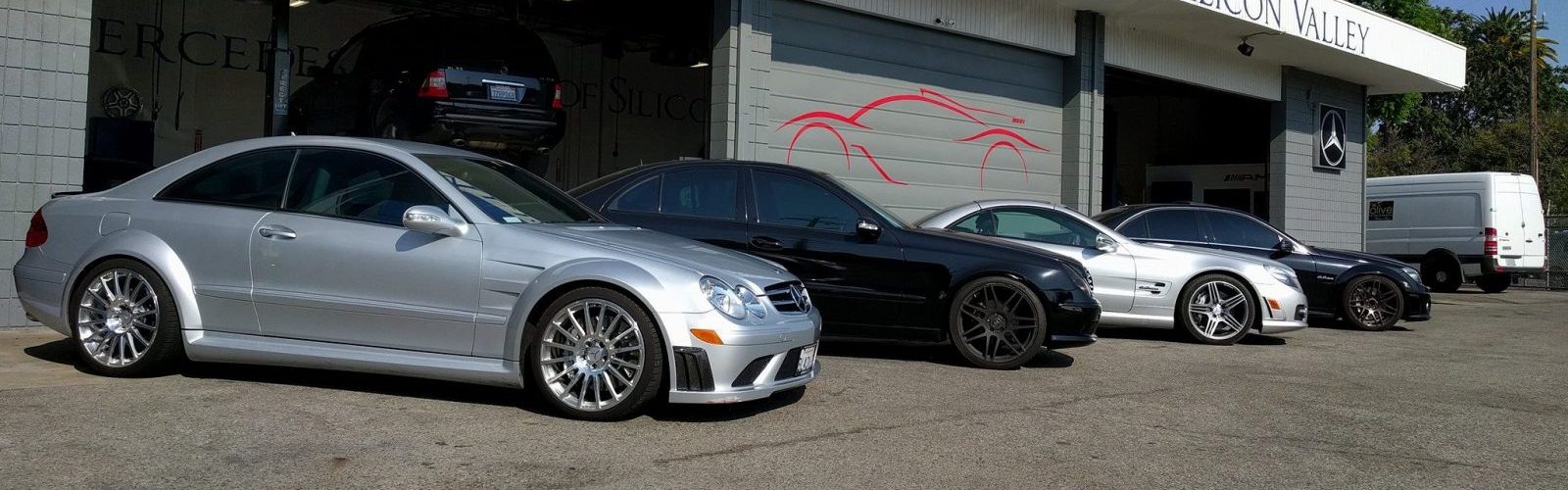
At Mercedes Service of Silicon Valley, alignment concerns are approached as chassis concerns first. Before adjustments are made, the technician should establish whether a worn component, damaged wheel, tire issue, or ride-height fault is causing the geometry to drift. That protects the customer from paying for an alignment that will not hold.
The value of Mercedes-specific experience
Mercedes suspension designs can be precise, sophisticated, and sensitive to wear. Multi-link rear suspensions, electronically controlled dampers, AIRMATIC systems, rear-wheel steering, and performance-oriented AMG geometry all require more than a quick toe adjustment.
An experienced Mercedes technician knows where these vehicles commonly develop play, how to recognize a bent adjustment eccentric, and when a tire wear issue points to a failed bushing rather than a setting that simply moved out of specification. This matters because alignment readings can look acceptable while a worn control arm bushing allows the wheel angle to change under braking or cornering.
Equipment matters, but process matters more
Modern camera-based alignment equipment is highly accurate when it is correctly calibrated and used by a trained operator. What separates a thorough service from a rushed one is the process around the machine.
The vehicle should be inspected for loose steering or suspension components, tire damage, uneven tread depth, wheel bends, and improper tire pressure. Ride height should be evaluated where applicable. The steering wheel must be centered, and the vehicle needs the correct Mercedes specification loaded into the system. If the vehicle has steering-angle or driver-assistance systems affected by the repair, calibration may also be required.
A printout alone does not tell the full story. It shows measured angles at one moment. A skilled technician explains what was adjusted, what could not be adjusted, and whether any component condition may affect the result over time.
When a Mercedes Needs More Than an Alignment
Not every pulling or vibration complaint is an alignment problem. Tires are frequently the source. A tire with internal belt separation can create a pull, while a bent wheel can cause vibration that feels like a steering issue. Road crown can also create a mild drift, especially on certain highways.
Suspension wear is another common factor. Control arm bushings, ball joints, tie rods, wheel bearings, and subframe components must be secure before alignment angles can remain stable. If a technician identifies worn parts, replacing them before the final alignment is the honest recommendation. Aligning first and repairing later usually means paying twice.
For vehicles with air suspension, ride height is especially relevant. A leaking strut, failing level sensor, or calibration issue can change the vehicle’s static position and alter the alignment relationship. The chassis system should be functioning correctly before final measurements are set.
What a Thorough Mercedes Alignment Visit Should Include
A quality alignment appointment should begin with questions, not assumptions. The shop should ask whether the vehicle pulls, vibrates, wanders, has recently hit a pothole, or received new tires or suspension parts. Those details guide the inspection.
The service should then include a tire and wheel check, a visible suspension and steering inspection, measurement of current alignment angles, and adjustment using the proper Mercedes specifications. You should receive a before-and-after report and a clear explanation if an angle remains outside specification due to a damaged or non-adjustable component.
For lowered vehicles, performance modifications, or aftermarket wheels, the discussion needs more nuance. Factory settings are often the best baseline for street-driven cars, but a performance setup may call for different targets based on tire type, ride height, track use, and the owner’s priorities. More negative camber can improve cornering response, for example, but it may increase inner-edge tire wear if toe is not managed carefully. There is no one “performance alignment” that suits every Mercedes.
How Often Should You Check Alignment?
There is no fixed mileage interval that fits every driver. A check is sensible after a significant pothole impact, curb strike, suspension repair, steering repair, new tire installation, or uneven tire wear. It is also worthwhile when the steering wheel is off-center, the vehicle drifts, or handling no longer feels settled.
For commuters driving San Jose, Fremont, Milpitas, and surrounding roads, a periodic inspection can be inexpensive insurance against premature tire replacement. Tires on Mercedes models are often performance-oriented and costly. Catching a toe issue early can preserve thousands of miles of usable tread.
Choosing the Right Alignment Shop
Ask whether the shop regularly aligns Mercedes-Benz vehicles, uses current vehicle-specific specifications, performs a suspension inspection before adjustment, and can handle needed calibration afterward. You should also ask for an explanation of any recommended repairs and a copy of the final measurements.
The right choice is not automatically the dealer or automatically the independent. It is the shop that understands your Mercedes, diagnoses the full condition of the chassis, uses proper equipment and data, and communicates clearly about what the car needs and what it does not. When the steering feels settled, the tires wear evenly, and the vehicle tracks with confidence, that attention to detail shows up on every drive.