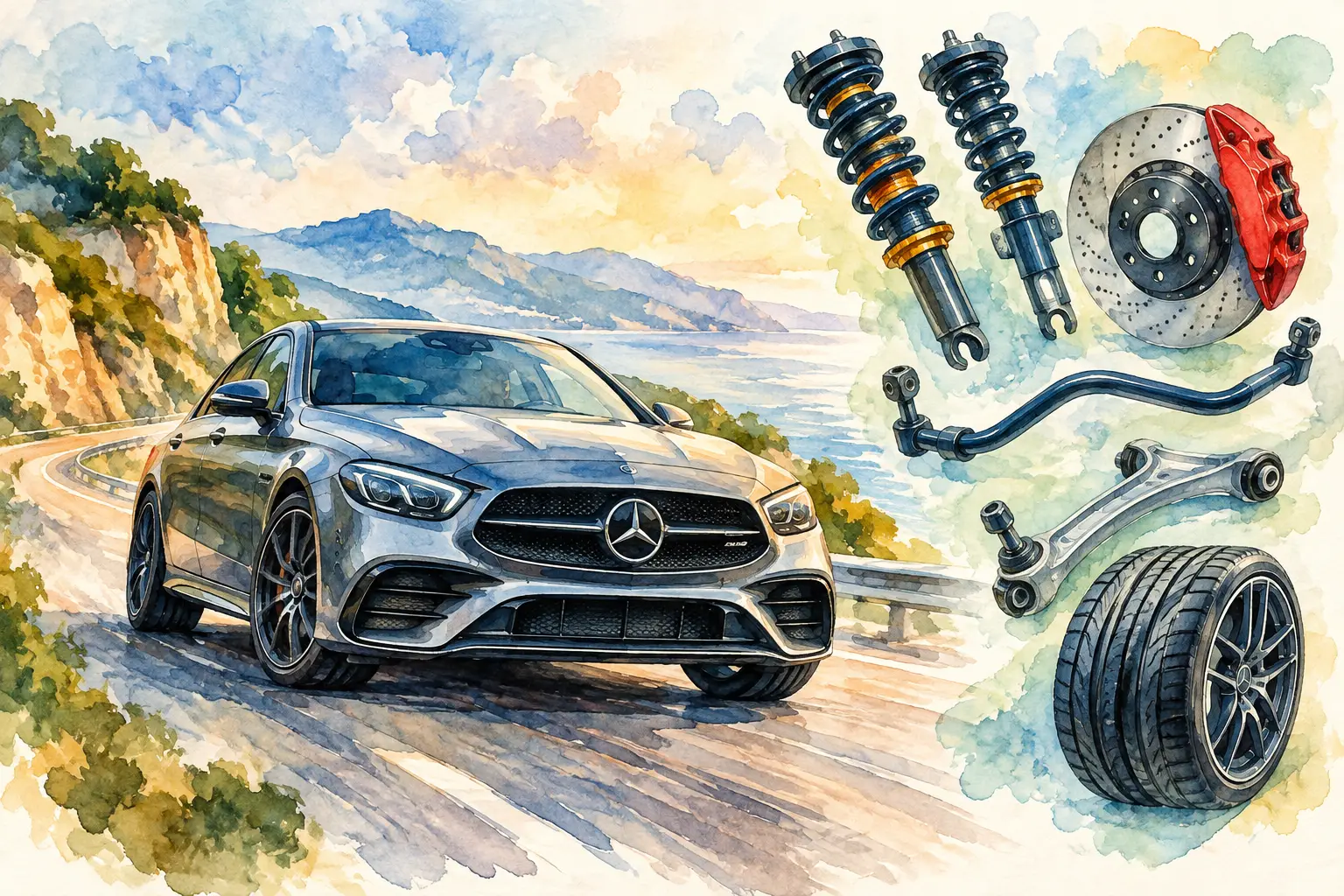
A Mercedes that feels vague over a mid-corner bump, leans too much on an on-ramp, or follows grooves in the pavement does not always need a major performance build. The best upgrades for Mercedes handling usually begin with correcting the fundamentals, then choosing components that suit the vehicle, the driver, and the roads it sees every week.
That approach matters in Silicon Valley, where a daily commute may include uneven city streets, highway expansion joints, and a weekend drive through the Santa Cruz Mountains. A modification that feels sharp on smooth pavement can become tiring or unpredictable on broken roads. The goal is not simply a stiffer Mercedes. It is a more controlled, confident, and balanced one.
Best Upgrades for Mercedes Handling Start With a Baseline
Before installing performance parts, confirm that the existing chassis is healthy. Worn control arm bushings, tired dampers, uneven tire wear, loose steering components, or an alignment outside specification can make even an excellent suspension package feel disappointing. On older Mercedes-Benz models in particular, rubber bushings and suspension links can gradually deteriorate without producing an obvious noise.
A proper inspection should include tire condition and pressures, ride height, wheel bearings, ball joints, control arms, tie rods, dampers, and all relevant electronic suspension components. Mercedes models equipped with AIRMATIC, ABC, AMG Ride Control, or adaptive damping need diagnosis before modifications are considered. Replacing parts without identifying the root cause can add cost without fixing the handling concern.
This is also the right time to verify wheel and tire fitment. A bent wheel, mismatched tires, or incorrect load rating can undermine every other upgrade. Factory-level diagnostic equipment and Mercedes-specific experience are valuable here because modern chassis systems often use steering angle, ride-height, and stability-control inputs to determine how the car responds.
Tires Deliver the Biggest Immediate Change
For most owners, tires are the highest-value handling upgrade. They are the only parts of the car that touch the road, and their compound, construction, size, and pressure have an outsized effect on turn-in, braking stability, ride quality, and wet-weather confidence.
A quality max-performance summer tire can transform steering response on a C-Class, E-Class, or AMG, but it is not automatically right for every driver. Summer tires need appropriate temperatures and can be a poor choice for someone who regularly travels to colder climates. A premium ultra-high-performance all-season tire may provide a better year-round balance for a daily-driven Mercedes in the Bay Area.
Avoid choosing tires by appearance alone. Wider is not always better. An overly wide tire can add tramlining, increase steering effort, and create clearance issues under suspension compression. The correct choice depends on the wheel width, vehicle weight, alignment settings, power level, and how the vehicle is used. Matching all four tires by model and maintaining the correct staggered setup, where applicable, is especially important on Mercedes-Benz vehicles.
Alignment Is Where the Upgrade Comes Together
A precise alignment often produces a more noticeable improvement than an expensive bolt-on part. Alignment settings determine how the tires meet the pavement during braking, cornering, and straight-line driving. Even a car with new tires and suspension components will not perform properly if the geometry is off.
Factory alignment specifications are a strong starting point for most Mercedes owners. For a street-focused performance setup, modest adjustments to camber and toe can improve cornering grip and steering precision while preserving reasonable tire life. More negative camber can help the outside tire stay planted in a hard corner, but too much will wear the inner shoulder of the tire quickly on a commuter vehicle.
Toe settings require the same restraint. A small change can make a car feel more eager to turn, while excessive toe can make it nervous at highway speeds and consume tires rapidly. The right alignment is tailored, not extreme. It should account for ride height, wheel and tire dimensions, and the driver’s priorities.
Lowered vehicles deserve particular care. Changing ride height changes suspension geometry. After springs, coilovers, or adjustable links are installed, the car should be aligned at its final ride height. Certain performance applications also benefit from corner balancing, which distributes weight more evenly across the chassis and helps the vehicle behave consistently from left turns to right turns.
Dampers and Springs Should Be Chosen as a System
Springs control ride height and help manage body movement. Dampers control the springs’ motion. Installing lowering springs on worn factory shocks is one of the most common ways to create a harsh, unsettled ride. The car may sit lower, but it can bounce over rough surfaces and lose composure when pushed.
For a daily-driven Mercedes, matched springs and dampers are often the smartest suspension upgrade. They can reduce body roll and improve response without sacrificing the refined ride quality that makes the brand special. A well-engineered package also preserves adequate suspension travel, which is critical on real roads.
Coilovers offer more ride-height adjustment and, in many cases, adjustable damping. They can be an excellent choice for track days, aggressive canyon driving, or a carefully planned AMG build. They also demand more thoughtful setup. Setting a car too low reduces available travel and can cause bottoming, poor bump response, accelerated tire wear, and clearance problems. The lowest setting is rarely the best-handling setting.
Owners of vehicles with adaptive suspension should be cautious about replacing components simply for the sake of modification. Depending on the model, retaining and properly calibrating the factory system may deliver better results than deleting it. When an aftermarket solution is appropriate, it should be compatible with the vehicle’s electronics and installed with the necessary coding or calibration.
Sway Bars, Bushings, and Chassis Components Refine the Feel
Once tires, alignment, and primary suspension control are sorted, sway bars can reduce body roll and sharpen transitions. A larger front bar generally increases front roll resistance, while a larger rear bar can help the vehicle rotate more readily. The balance matters. Too much rear bar can make a rear-wheel-drive Mercedes feel abrupt at the limit, especially on uneven pavement or in wet conditions.
Fresh bushings can make a remarkable difference on higher-mileage vehicles. Control arm bushings, subframe mounts, and engine or transmission mounts influence how directly the chassis responds to driver inputs. OEM-style rubber components often provide the best blend of precision and comfort for street use. Polyurethane or solid bushings can improve response further, but may introduce noise, vibration, harshness, and additional maintenance needs.
Chassis bracing is more situational. A brace can be useful on some performance builds, but it should not be expected to cure poor alignment, worn suspension parts, or inadequate tires. It belongs later in the upgrade path, not at the beginning.
Do Not Overlook Brakes and Driver Confidence
Brakes do not create cornering grip, but consistent braking changes how confidently a driver can approach a corner. Fresh high-quality pads, properly serviced calipers, suitable brake fluid, and healthy rotors help the vehicle remain stable during repeated stops. For spirited road use, choose components that work well at street temperatures rather than selecting a race-oriented pad that squeals, dusts heavily, and performs poorly when cold.
Mercedes stability and traction systems are also part of the handling equation. Wheel-size changes, suspension modifications, and alignment work should respect the vehicle’s electronic safety systems. If warning lights appear after chassis work, the correct response is diagnosis and calibration, not ignoring the warning or disabling a system.
Build for How You Actually Drive
The ideal handling package differs between a GLE that carries family and cargo, an E-Class commuter, a Sprinter with a commercial load, and an AMG used for weekend events. A luxury sedan owner may value a planted highway feel and clean steering response. An enthusiast may accept a firmer ride for more front-end grip and less roll. Neither choice is wrong when the trade-offs are understood.
A sensible order of operations is simple: inspect the chassis, install the right tires, align the vehicle accurately, then select suspension and supporting components that match the intended use. This prevents a collection of expensive parts from working against one another.
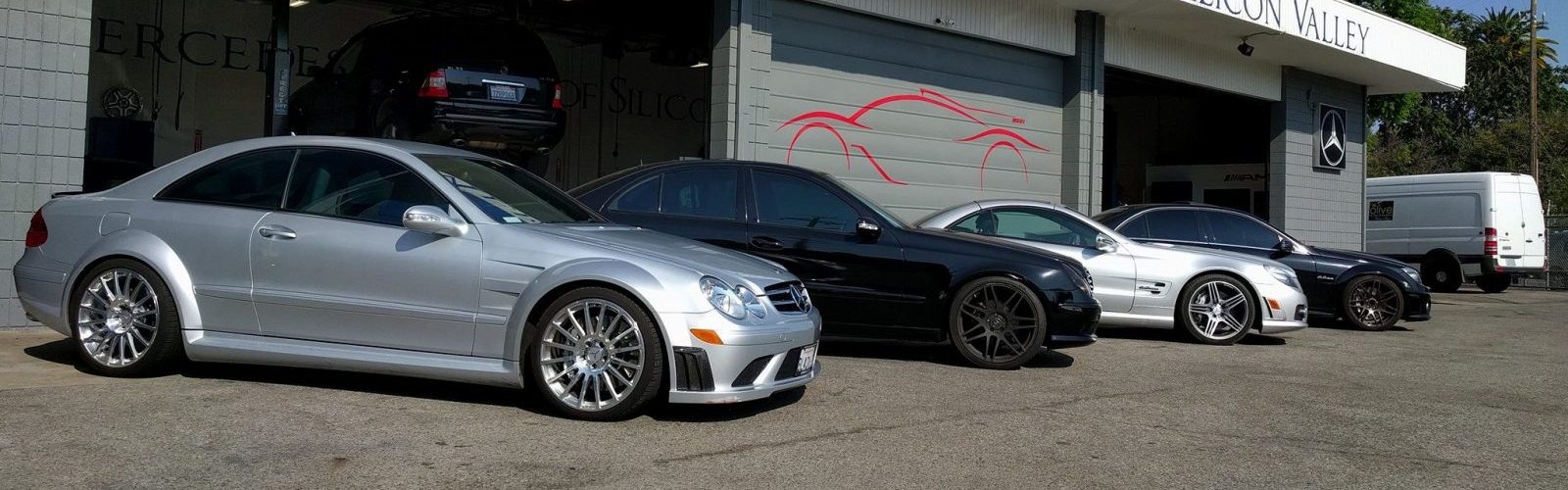
At Mercedes Service of Silicon Valley, thoughtful recommendations begin with how you use your vehicle, not with a generic parts list. The best result is a Mercedes that feels more connected and composed while retaining the safety, reliability, and character you bought it for.