When your Mercedes drops overnight, starts riding harsh, or throws an AIRMATIC warning, the real question is not just what failed. It is whether airmatic repair vs replacement makes better sense for your car, your budget, and how long you plan to keep it. That decision is rarely one-size-fits-all, especially on older Mercedes models where one failed component can point to wear elsewhere in the system.
How to think about airmatic repair vs replacement
AIRMATIC is one of the features that makes a Mercedes feel like a Mercedes. When it is working correctly, the ride stays composed, the vehicle sits at the proper height, and the suspension adapts the way it should. When it starts failing, owners often hear very different advice. One shop may recommend replacing only the leaking air strut. Another may push for a compressor, valve block, and multiple corners at once.
The truth is that both approaches can be right. A targeted repair is often the smart move when the failure is isolated and the rest of the system tests well. Replacement becomes the better value when several parts are worn, the vehicle has high mileage, or a delayed repair has already overworked other components.
This is where Mercedes-specific diagnostics matter. AIRMATIC problems can look similar from the driver’s seat, but the root causes are not always the same. A sagging front corner may be a leaking strut, a tired valve block, a fitting leak, or a compressor that can no longer maintain pressure under normal load.
What usually fails in a Mercedes AIRMATIC system
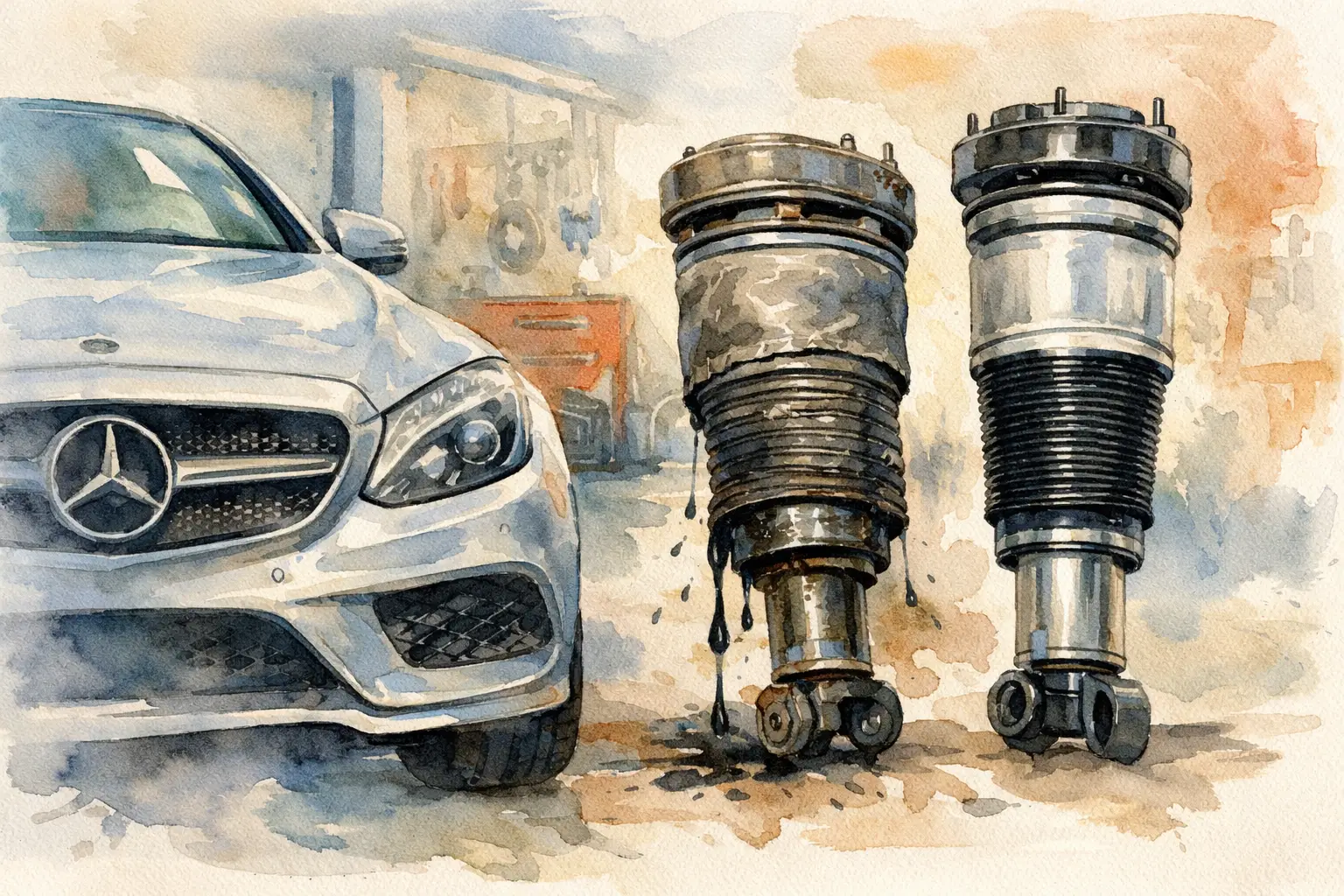
Most owners think of the air struts first, and for good reason. The rubber air bladder ages, cracks, and eventually leaks. But the struts are only part of the picture. The compressor, valve block, air lines, level sensors, and control electronics all play a role in ride height and system pressure.
On many Mercedes vehicles, the compressor ends up suffering after a leak has gone unaddressed. It keeps cycling to maintain height, runs hotter and longer than intended, and wears out faster. That is why waiting too long on a small leak often turns a repair into a bigger bill.
Mileage and age matter too. A ten-year-old Mercedes with one visibly failed front strut may still have three other original components that are not far behind. That does not automatically mean replace everything, but it does mean the diagnosis should look at the system as a whole rather than only the corner that dropped.
When airmatic repair is the better choice
A focused repair is usually the right call when testing shows one clear failure and the surrounding components are still healthy. If a single air strut is leaking, the compressor output is within spec, and the valve block is functioning properly, replacing that one failed part may restore the system without unnecessary expense.
This approach often makes sense for lower-mileage vehicles or for owners who caught the problem early. It can also be the best path when the issue is something smaller, such as a leaking line fitting, a height sensor fault, or a valve block problem that has not damaged the compressor.
There is a cost advantage here, but only if the diagnosis is accurate. Replacing one part without confirming the rest of the system can lead to repeat visits and frustration. On a Mercedes, that is where factory-level scan tools and pressure testing separate a proper repair from guesswork.
Repair also makes sense when the goal is to keep the vehicle reliable without replacing parts that still have good service life left. Good shops do not replace major suspension components just because they are old. They replace them when the condition and test results justify it.
When replacement makes more sense
The case for replacement gets stronger when the system shows multiple wear points. If one corner is leaking and the compressor is already slow to build pressure, replacing only the strut may not solve the full problem for long. The same goes for vehicles where more than one air spring is cracked or where the system has a pattern of recurring faults.
High-mileage Mercedes SUVs and sedans often reach a point where replacement is simply more practical than piecemeal repairs. If the original AIRMATIC components have aged together, doing one part at a time can end up costing more over the next year than addressing the system more comprehensively.
There is also a drivability and safety factor. A weak AIRMATIC system can affect ride quality, tire wear, braking stability, and how confidently the vehicle handles under load. If the suspension cannot maintain proper ride height or reacts inconsistently, replacement may be the better decision even before a complete failure leaves the car sitting low.
Airmatic repair vs replacement depends on diagnosis, not guesswork
This is the part many owners miss. AIRMATIC decisions should not start with internet forums or a parts list. They should start with testing. Ride height readings, fault codes, compressor performance, leak-down behavior, and visual inspection all matter.
A proper diagnosis answers a few basic questions. Is the problem isolated or systemic? Has the compressor been overworked? Are there signs of age-related cracking on other air springs? Is the valve block holding pressure correctly? Those answers change the recommendation.
For example, if a Mercedes arrives with one rear corner sagging overnight but the compressor runs normally and the rest of the system holds pressure, a single-corner repair can be entirely reasonable. If that same vehicle also shows long compressor run times, multiple stored pressure faults, and visible cracking at another air spring, replacement planning becomes a lot more sensible.
That is why honest shops do not jump straight to the biggest estimate. They diagnose first, explain what is failing now, and point out what may be close behind.
The cost question owners really care about
Most people asking about airmatic repair vs replacement are trying to avoid paying twice. That is the right instinct. The cheapest invoice today is not always the least expensive path overall.
A single targeted repair can save substantial money if the rest of the system is in good shape. But if you are replacing one worn-out component in a system where others are near the same end point, you may only be buying a short period before the next failure. That is not upselling. It is simply the reality of age and wear.
On the other hand, full system replacement is not automatically justified just because the car is older. Plenty of Mercedes owners are told to replace more than necessary because it is easier to sell a broad repair than to do the work of precise testing. A shop with real Mercedes experience should be able to tell you where targeted repair ends and false economy begins.
Model, mileage, and ownership plans all matter
A driver planning to keep a well-maintained Mercedes for several more years may benefit from a more complete AIRMATIC refresh when multiple components are aging out together. That can reduce repeat labor, improve ride quality, and restore confidence in the vehicle.
A different owner may be dealing with one isolated issue on a lower-mileage car and only need a straightforward repair. Neither choice is universally right. It depends on the condition of the vehicle and your plans for it.
Driving habits matter too. A daily commuter covering Bay Area miles every week will feel the downside of a marginal suspension system faster than a car driven occasionally. The same applies to heavier vehicles and Mercedes SUVs, where suspension load and compressor demand can be higher.
What Mercedes owners should expect from a good recommendation
A trustworthy AIRMATIC recommendation should be specific. You should hear what failed, how it was confirmed, what other components were checked, and whether there is evidence of secondary wear. You should also hear the trade-off between repairing only the failed part and replacing more of the system.
At Mercedes Service of Silicon Valley, that is how these conversations should go. Mercedes owners deserve a clear answer based on factory-trained experience and actual test results, not generic suspension advice. AIRMATIC systems are too model-specific and too expensive to approach any other way.
If your Mercedes is sagging, riding rough, or warning you about the suspension, the best next step is not to assume the worst or chase the lowest quote. Get the system diagnosed properly, understand whether the failure is isolated or part of a bigger wear pattern, and make the decision that fits both the car and your plans for it. A well-informed repair is almost always cheaper than guessing.