
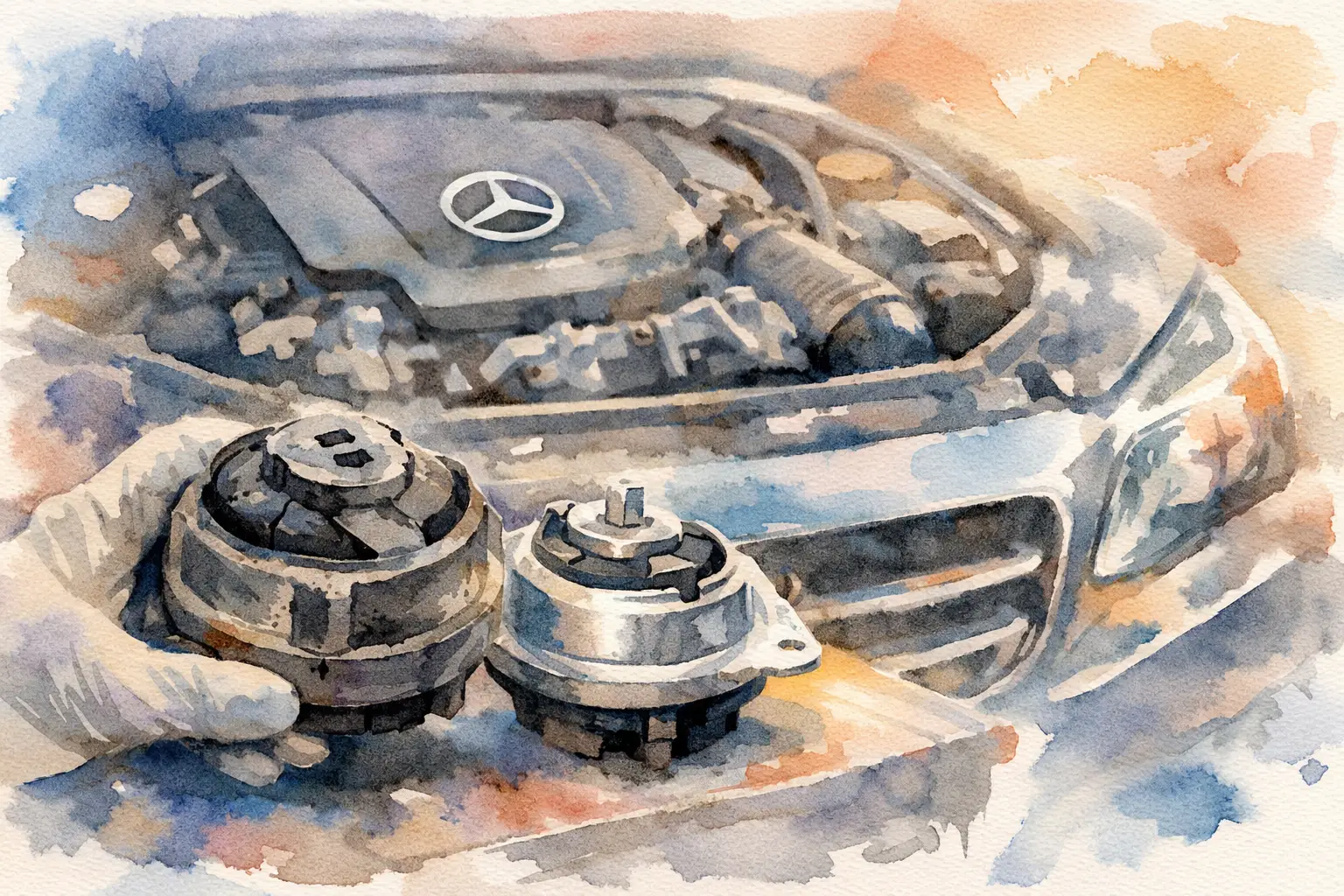
The best signs of failing motor mounts are often felt before they are seen: a sharp thump when selecting Drive, an unfamiliar vibration at a stoplight, or a rough jolt when your Mercedes shifts. These symptoms can be easy to dismiss, especially when the vehicle still drives normally. But motor mounts do far more than hold the engine in place. They control engine movement, isolate vibration, and help protect connected components throughout the drivetrain.
Mercedes-Benz vehicles are engineered for a composed, quiet driving experience. When that refinement changes, the cause deserves proper diagnosis. A worn mount is not always the answer, but it should be high on the list when vibration or drivetrain movement becomes noticeable.
Why Motor Mounts Matter on Mercedes-Benz Vehicles
Motor mounts secure the engine to the chassis while allowing a controlled amount of movement under acceleration, braking, and shifting. Many Mercedes models use hydraulic mounts, and some applications use electronically controlled mounts designed to reduce vibration even further. The transmission mount works with them to support the drivetrain as a complete system.
Over time, rubber can deteriorate, hydraulic fluid can leak from fluid-filled mounts, and internal mount components can lose their ability to dampen movement. Heat, frequent stop-and-go driving, spirited acceleration, oil contamination, and age all contribute. The result is a vehicle that may feel less smooth, less responsive, and less settled than it did before.
10 Best Signs of Failing Motor Mounts
1. Excessive Vibration at Idle
A vibration through the steering wheel, seat, center console, or floor at idle is one of the most common symptoms. It may be most noticeable when the engine is warm and the transmission is in Drive with the brake applied. If the vibration reduces when shifted into Park or Neutral, worn motor mounts are a strong possibility.
Still, idle vibration can also come from an engine misfire, ignition issue, vacuum leak, or driveline concern. A Mercedes-specific inspection is the right way to separate a mount issue from an engine performance problem.
2. A Clunk When Shifting Into Drive or Reverse
A distinct clunk or thump when moving from Park into Drive or Reverse can indicate that the engine is moving more than it should. Healthy mounts cushion that movement. When a mount has collapsed, separated, or lost its hydraulic damping, the drivetrain can shift abruptly as torque is applied.
This symptom can overlap with transmission, differential, or driveline play. The sound alone does not justify replacing parts, which is why checking the mounts and related components together matters.
3. A Jolt During Acceleration or Braking
If your Mercedes gives a brief but noticeable lurch when you accelerate from a stop or come off the throttle, the engine may be rocking against weakened mounts. You may also feel a jolt when braking firmly as the drivetrain shifts forward.
AMG models and other higher-output Mercedes vehicles can make this symptom more apparent because they place greater torque loads on the mounts. That does not mean every performance car needs stiffer aftermarket mounts. For most street-driven vehicles, OEM-quality mounts preserve the refined feel Mercedes intended.
4. Unusual Movement Under the Hood
A technician may observe excessive engine movement during a controlled inspection while the vehicle is shifted between gears or lightly loaded. Do not attempt to inspect this yourself near moving belts, fans, or a running engine. What looks like a small amount of movement can be difficult to judge without knowing the normal behavior of that specific Mercedes engine and chassis.
Collapsed mounts may also cause the engine to sit slightly lower or at an uneven angle. On some vehicles, visible hydraulic fluid leakage around a mount provides a clear clue, though not every failed mount leaks externally.
5. A Thump Over Bumps or Uneven Roads
A worn engine or transmission mount can allow the drivetrain to move enough to create a dull thump over potholes, driveway transitions, or rough pavement. The sound may seem to come from the front suspension, especially inside the cabin.
Because control arm bushings, sway bar links, strut mounts, and underbody panels can create similar noises, this is another case where diagnosis should come before repairs. Replacing mounts when the actual issue is in the suspension will not solve the problem.
6. Increased Cabin Noise
Motor mounts are vibration isolators. Once their rubber hardens, collapses, or separates, more engine noise and harshness can travel into the cabin. A Mercedes that once felt quiet at idle may develop a low-frequency drone or a coarse mechanical feel through the pedals and seats.
This change can happen gradually, making it easier to notice after driving another vehicle or taking a longer trip. Owners often describe it simply as the car feeling “older” or less polished than usual.
7. Rougher or More Noticeable Gear Changes
Failing mounts do not usually cause a transmission fault, but they can make normal shifts feel harsher. When the powertrain is not properly supported, the movement that occurs during a shift becomes more obvious to the driver.
Before assuming a transmission problem, a qualified technician should evaluate engine and transmission mounts, fluid condition where applicable, fault codes, and the vehicle’s shift behavior. This approach avoids unnecessary transmission work and identifies the actual source of the concern.
8. Exhaust Contact or Rattling
Exhaust components are designed around the engine’s normal range of movement. If worn mounts allow the engine to sag or rock excessively, the exhaust may contact a heat shield, crossmember, or other underbody component. That can create a metallic rattle, particularly during acceleration or when the engine starts and stops.
Ignoring this type of contact can lead to damaged heat shields, exhaust flex sections, or mounting hardware. A small rattle is worth addressing before it turns into a larger repair.
9. New Noises After Engine Start or Shutdown
The engine naturally moves as it fires up and shuts down. Weak mounts can make that motion feel abrupt, producing a brief knock, bump, or shudder. On vehicles with start-stop systems, a mount problem may be especially noticeable because the engine cycles more frequently in traffic.
The noise may be intermittent and temperature-dependent. Hydraulic mount fluid can behave differently when cold versus hot, so a road test and inspection should consider the conditions under which the symptom occurs.
10. Visible Mount Damage or Fluid Leakage
During a proper inspection, damaged rubber, separated mount sections, collapsed mount height, or leaked hydraulic fluid can confirm the need for replacement. Some mounts fail internally without dramatic visual evidence, so physical appearance is only one part of the evaluation.
Mercedes diagnostic equipment can also help identify related engine faults or electronically controlled mount concerns on applicable models. The goal is not to sell mounts because they are common wear items. It is to verify that they are responsible for the complaint.
What Happens If You Keep Driving?
A mildly worn mount is not always an immediate safety emergency, but it should not be ignored. As the mount deteriorates, excessive drivetrain movement can add stress to hoses, wiring, exhaust components, intake plumbing, axles, and transmission connections. It can also make the vehicle less comfortable and allow minor noises to become more severe.
How quickly repair is needed depends on the condition of the mount and the symptoms. A small increase in vibration may allow time to schedule service. A heavy clunk, obvious engine movement, exhaust contact, or a sudden change in shifting behavior calls for a prompt inspection. If the vehicle is making violent noises or feels unsafe to drive, it should not be pushed through a commute.
What a Proper Motor Mount Diagnosis Looks Like
Motor mount diagnosis should begin with a conversation about when the symptom occurs: cold start, idle, gear engagement, acceleration, braking, or rough roads. A technician can then inspect the mounts, transmission mount, drivetrain supports, exhaust clearances, and nearby components for evidence of movement or contact.
The engine also needs to be checked for faults that can mimic mount failure. A rough-running engine can make good mounts feel bad, while failed mounts can exaggerate normal engine vibration. On a Mercedes-Benz, accurate diagnosis means considering both mechanical condition and electronic fault data rather than guessing from a single noise.
If replacement is needed, using correct-fit OEM or OEM-quality components matters. The least expensive mount may fit physically but fail to restore the smoothness, durability, and isolation expected from the vehicle. Replacing related mounts as a set can make sense when they have aged together, but it depends on their actual condition and the vehicle’s design.
At Mercedes Service of Silicon Valley, we approach mount concerns the same way we approach every repair: inspect carefully, explain what we find, and recommend only the work the vehicle needs. If your Mercedes no longer feels as smooth at idle or as controlled under acceleration as it should, a focused inspection can protect both its refinement and the components connected to its drivetrain.
A Mercedes rarely loses its polished feel without a reason. Paying attention to that first vibration, clunk, or jolt gives you the best chance to correct a small issue before it affects the driving experience you bought the vehicle for.