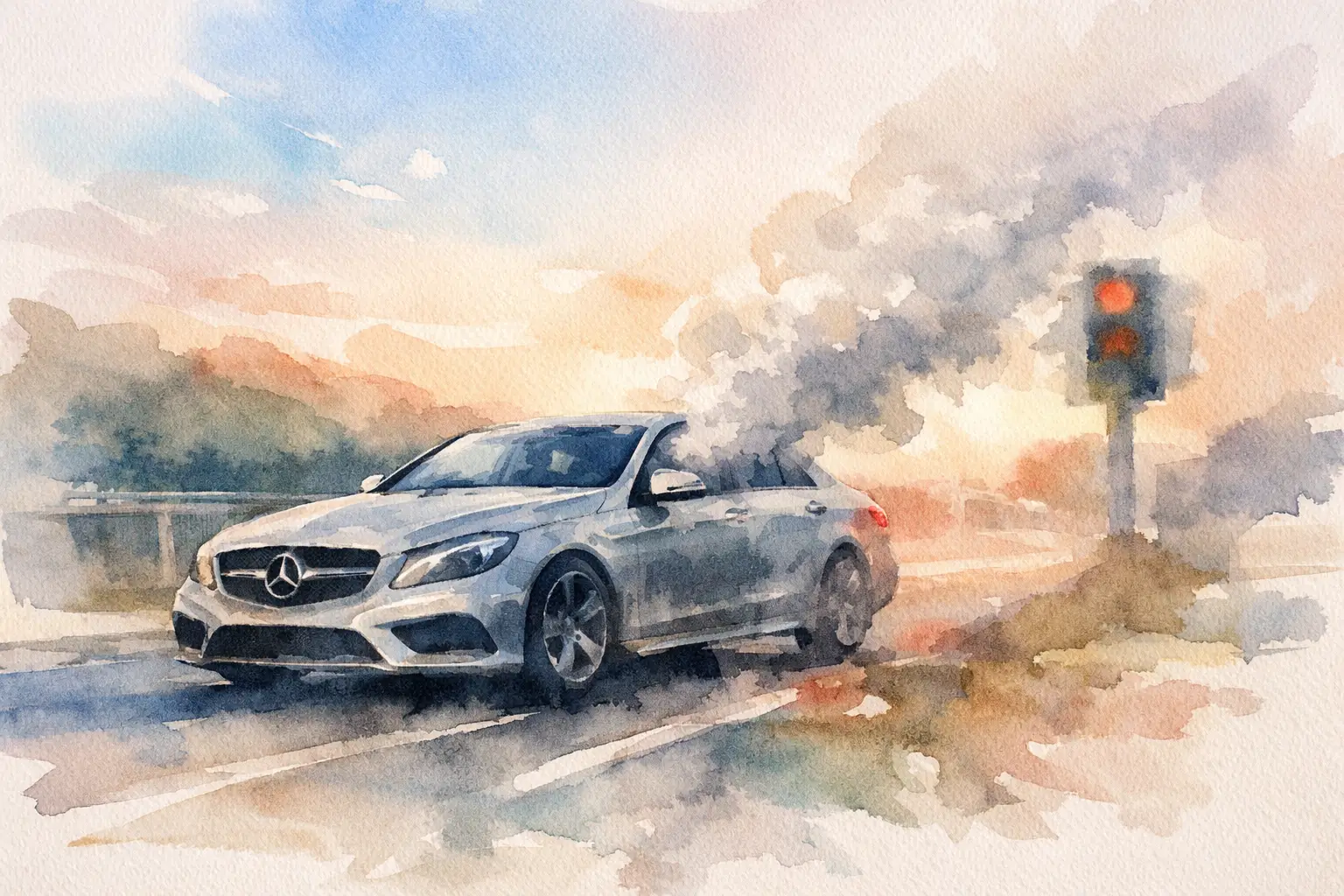
A Mercedes that suddenly will not accelerate normally, will not shift past a certain gear, or displays a warning light has likely entered a protective strategy. The question “why does mercedes go limp mode” usually comes after a stressful drive, but limp mode is not the vehicle giving up. It is the control system limiting power or transmission operation to prevent a smaller fault from becoming major engine, transmission, or emissions-system damage.
Mercedes-Benz vehicles are highly integrated. The engine computer, transmission control unit, turbocharger controls, sensors, fuel system, and safety systems constantly compare commanded values with actual readings. When one of those readings falls outside an acceptable range, the vehicle may reduce power, limit RPM, or hold the transmission in a single gear. The correct repair depends on identifying the reason for the protection event, not simply clearing a warning light.
Why Does a Mercedes Go Into Limp Mode?
Limp mode is a response, not a diagnosis. On many late-model Mercedes models, it may feel like the car has lost its turbochargers, has little throttle response, or refuses to accelerate beyond moderate speed. On others, especially vehicles with automatic transmission concerns, the transmission may stay in second gear or another fixed gear to allow limited mobility.
The behavior can be intermittent. A vehicle may drive normally after being switched off and restarted, then enter limp mode again under hard acceleration, climbing a grade, towing, or sitting in Silicon Valley traffic on a hot afternoon. That pattern is useful diagnostic information. It often means the fault occurs only when the system is under a specific load, temperature, or pressure condition.
A restart can remove the immediate restriction, but it does not correct the stored fault or the condition that triggered it. Continuing to drive aggressively after repeated limp-mode events can turn a repairable issue into a more expensive one.
Common Causes on Mercedes-Benz Vehicles
Turbocharger and boost-pressure faults
On turbocharged Mercedes engines, one of the most common triggers is a boost-pressure reading that does not match what the engine computer expects. A split charge-air hose, loose connection, leaking intercooler pipe, worn turbo actuator, vacuum leak, or sticking wastegate can all cause underboost or overboost conditions.
A boost leak may be accompanied by a whooshing sound, reduced acceleration, or oil residue around a hose connection. Still, visual inspection alone is not enough. Some leaks only open when the intake tract is pressurized. A proper diagnosis compares requested boost with actual boost and tests the system under the conditions where the fault occurs.
Sensor and electrical issues
Mercedes vehicles rely on precise information from sensors such as the mass air flow sensor, manifold pressure sensor, crankshaft position sensor, camshaft position sensors, oxygen sensors, and temperature sensors. A sensor can send an implausible signal without failing completely. Damaged wiring, corroded connectors, weak grounds, and voltage issues can create the same result.
This is why replacing parts based solely on a generic code can be costly. A fault code identifies the system that needs attention, but it does not always identify the failed component. Factory-level diagnostic equipment and live data help determine whether the issue is the sensor, its wiring, a mechanical problem, or another system causing the reading to be incorrect.
Transmission control faults
If your Mercedes starts but shifts harshly, will not upshift, or remains in one gear, the transmission may be in limp-home mode. Causes vary by model and transmission generation. Low or degraded transmission fluid, conductor plate or internal speed-sensor faults, valve body issues, electrical connector leaks, and communication errors are all possibilities.
Transmission fluid is not a universal, lifetime item in real-world ownership. The correct Mercedes-approved fluid, service interval, fill procedure, and temperature-based level setting matter. Using the wrong fluid or filling it incorrectly can create shift concerns of its own. Before approving a major transmission repair, a specialist should inspect fault data, fluid condition, adaptation values, and related electrical systems.
Fuel, air, and emissions-system problems
Restricted fuel delivery, failing ignition components, intake air leaks, carbon buildup, and misfires can force the engine into reduced-power operation. On diesel Mercedes models and Sprinters, the emissions system adds other potential causes, including EGR faults, diesel particulate filter restrictions, NOx sensor faults, DEF system concerns, and exhaust pressure-sensor failures.
These systems should not be treated as an inconvenience to bypass. They are tied directly to engine operation and, on many vehicles, can affect reliability far beyond emissions compliance. The right repair starts with determining whether the issue is a sensor signal, a failed component, an exhaust restriction, or an operating condition preventing normal regeneration.
Cooling and temperature protection
An overheating engine can enter reduced-power mode to protect itself. Low coolant, a failing thermostat, water pump concerns, cooling fan faults, radiator restrictions, or an internal coolant leak can all contribute. If the temperature gauge is rising, a coolant warning appears, or steam is visible, pull over safely and shut the vehicle down. Driving an overheating Mercedes can cause severe engine damage quickly.
What to Do When Limp Mode Happens
First, reduce load on the vehicle. Avoid hard acceleration, high-speed driving, steep grades when possible, and towing. If the check engine light is flashing, the temperature is high, the oil-pressure warning is on, the transmission is slipping severely, or the vehicle has little ability to maintain safe traffic speed, stop driving and arrange for it to be inspected.
If the vehicle remains safe to operate, note what happened immediately before limp mode appeared. Did it occur during a freeway merge? After a long drive? Only when cold? Did any message appear in the instrument cluster? Those details can save diagnostic time because they help reproduce the fault.
Do not disconnect the battery or repeatedly clear codes before the vehicle is evaluated. That can erase valuable freeze-frame data and readiness information. It may also create additional warning messages that complicate the initial inspection. A basic code reader is useful for awareness, but it cannot access every Mercedes control module or provide the manufacturer-specific test plan needed for a confident repair.
Why Accurate Mercedes Diagnostics Matter
Modern Mercedes-Benz diagnostics are a process. A qualified technician confirms the customer concern, scans all relevant modules, reviews stored and pending faults, checks freeze-frame data, evaluates live readings, and performs targeted electrical or mechanical testing. The sequence matters.
For example, a code related to turbocharger performance may lead to a damaged hose, an actuator calibration issue, a sticking linkage, a boost sensor problem, or an exhaust restriction. Those repairs have very different costs. Replacing the turbocharger without proving it has failed is not transparent service, and it is not how a Mercedes specialist should approach the vehicle.
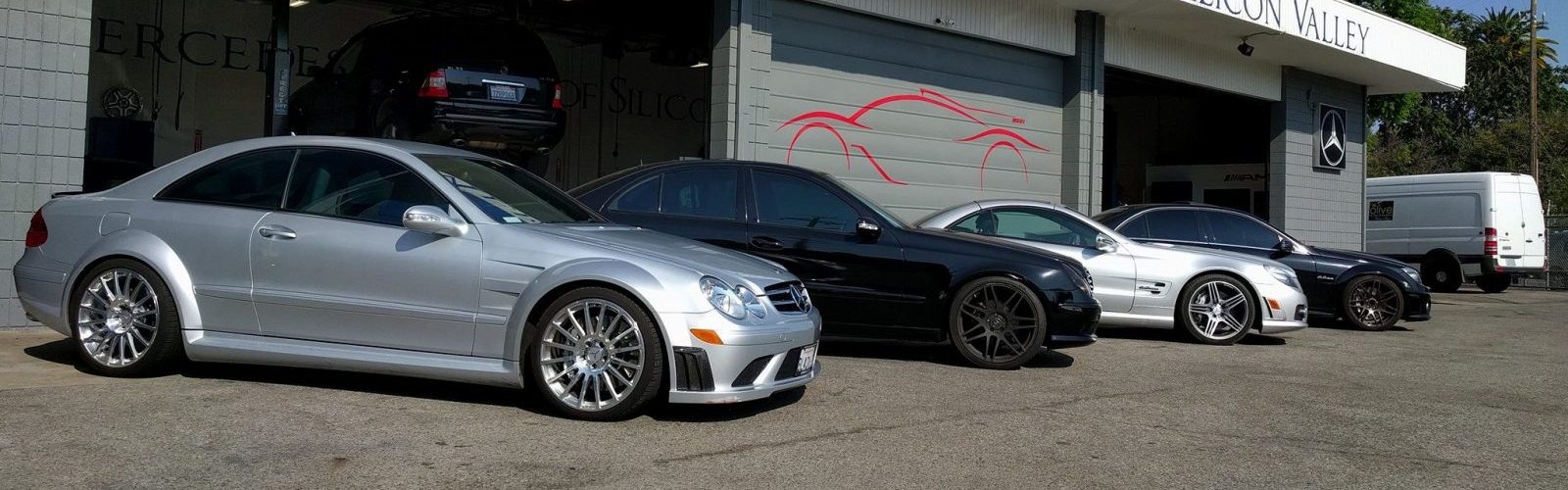
At Mercedes Service of Silicon Valley, our factory-trained approach is built around finding the cause before recommending repairs. We use Mercedes-capable diagnostic equipment, OEM-quality parts and fluids when required, and practical communication about what needs attention now, what can be monitored, and what may be preventive rather than urgent.
Can You Prevent Limp Mode?
Not every fault is preventable, especially as electronic components age. Consistent maintenance does reduce the risk. Oil changes with the correct Mercedes-approved oil, timely transmission service where applicable, cooling-system inspections, air-filter replacement, quality fuel, and prompt attention to warning lights all help protect the systems that commonly trigger reduced-power operation.
For AMG, turbocharged, diesel, and modified vehicles, maintenance and diagnostics should match how the vehicle is used. Performance tuning can increase heat and boost demand, so the underlying hardware must be healthy and the calibration must be appropriate for the vehicle. A well-executed modification should never be used to hide an existing fault.
Limp mode can feel alarming, but it is often your Mercedes giving you a chance to address a problem before it becomes a breakdown. Treat the warning as useful information, preserve the diagnostic evidence, and have the vehicle evaluated by technicians who understand how the entire Mercedes system is meant to operate.