
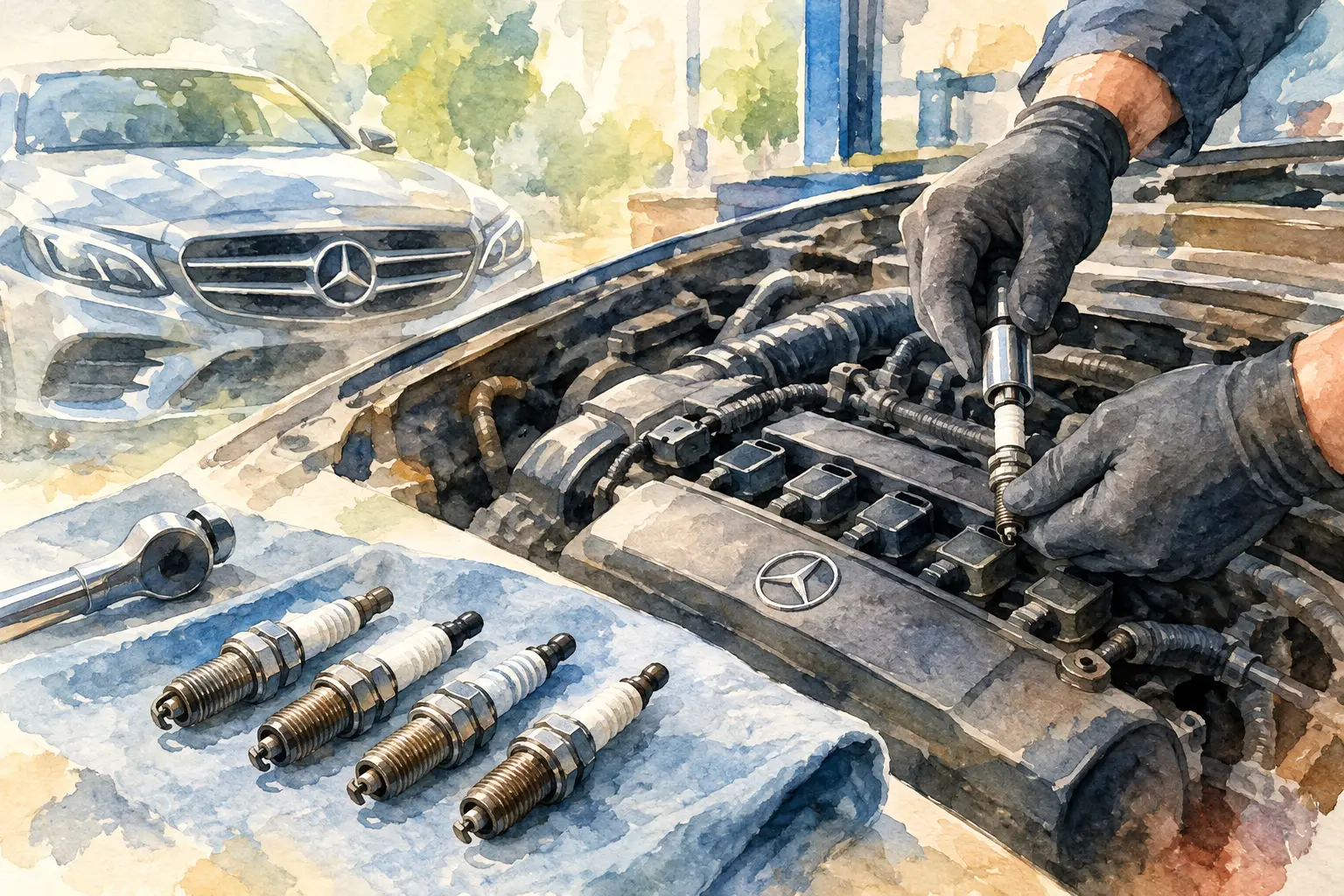
A Mercedes that hesitates under acceleration, idles less smoothly than usual, or delivers disappointing fuel economy may be asking for more than a quick tune-up. When it is time to replace Mercedes spark plugs, the correct parts, procedures, and diagnostic checks matter. These engines are precisely engineered, and a seemingly simple ignition service can affect performance, drivability, and long-term reliability.
For Silicon Valley drivers who rely on their Mercedes for daily commuting, weekend travel, or spirited driving, spark plug service should be handled with the same care as any other factory-scheduled maintenance. The goal is not merely to install new plugs. It is to restore consistent combustion while confirming there is not a separate issue causing the concern.
When to Replace Mercedes Spark Plugs
Mercedes-Benz service intervals vary substantially by model, engine, model year, and driving conditions. Many late-model gasoline engines use long-life spark plugs that may be scheduled around 60,000 to 100,000 miles, while certain AMG, turbocharged, or higher-performance applications can require replacement sooner. The maintenance booklet and factory service information for the specific vehicle should always guide the decision.
Mileage is not the only consideration. Frequent short trips, extended idling, heavy traffic, aggressive driving, oil consumption, or repeated heat cycles can shorten plug life. A high-performance turbocharged engine places especially high demands on its ignition system because cylinder pressures are greater under boost. That is one reason an AMG service schedule should never be assumed based on a standard Mercedes sedan.
Symptoms can point toward worn plugs, but they are not a diagnosis by themselves. Drivers may notice a rough idle, a stumble during acceleration, reduced power, harder starting, lower fuel economy, or a check engine light. In some cases, the engine may register a misfire fault. A flashing check engine light deserves immediate attention because an active misfire can send unburned fuel into the catalytic converter and cause expensive damage.
It is also worth making one distinction: diesel Mercedes-Benz vehicles do not use spark plugs. They use glow plugs to assist cold starting. Spark plug replacement applies to gasoline-powered Mercedes vehicles.
Why Mercedes Spark Plug Replacement Is Not Generic Maintenance
Spark plugs perform a basic job, but the specifications behind that job are highly vehicle-specific. The proper plug must match the engine’s required heat range, electrode design, reach, and factory gap specification. Installing a plug that is physically similar but not approved for the application can lead to poor combustion, misfires, pre-ignition concerns, or premature plug wear.
Mercedes engines may use plugs manufactured by respected OEM suppliers such as Bosch or NGK, but brand name alone is not enough. The correct part number matters. A technician should verify the vehicle by VIN and engine code rather than relying on a broad online parts listing. This is particularly important on vehicles with mid-year production changes or specialized AMG applications.
Installation accuracy matters just as much. Spark plugs thread into an aluminum cylinder head, and cross-threading or over-tightening can damage those threads. Under-tightening can affect heat transfer and sealing. The plugs should be installed using the appropriate factory torque specification, with careful attention to clean threads and the manufacturer’s guidance on lubricants or anti-seize compound. Applying anti-seize where it is not specified can alter torque readings and create its own problems.
Modern Mercedes ignition coils and coil boots also deserve inspection during the service. Heat and age can weaken coil boots, while oil in the spark plug wells may indicate a valve cover, breather, or seal-related issue that should be addressed. Replacing plugs without noticing those conditions can leave the actual cause of a misfire unresolved.
The Right Process to Replace Mercedes Spark Plugs
A quality spark plug service begins before any coils are removed. The technician should confirm the service history, scan the vehicle for stored fault codes, and evaluate any drivability complaint. If there is a misfire code, the cylinder-specific data helps determine whether the plug is likely at fault or whether the concern may involve an ignition coil, injector, air leak, fuel delivery issue, or internal engine condition.
After confirming the proper OEM-quality plugs, the technician removes the necessary engine covers and intake components carefully. Access varies widely. On some Mercedes four-cylinder engines, the plugs are relatively accessible. On V6, V8, and AMG engines, the job can involve more disassembly and more opportunities for damage if components, connectors, and vacuum lines are handled carelessly.
Each ignition coil is inspected as it comes out. The plug wells should be checked for moisture, oil, or debris before the old plugs are removed. Compressed air may be used to clear loose debris so it does not fall into the cylinder. The old plugs themselves provide useful evidence: unusual deposits, oil fouling, damaged electrodes, or a stark difference between cylinders may justify additional diagnosis.
New plugs are installed by hand first to protect the cylinder-head threads, then tightened to the required specification with the correct tool. Fine-wire iridium and platinum plugs should not be casually re-gapped. Their factory-set gaps and delicate electrodes can be damaged by improper handling. Once the coils and related components are reinstalled, a final scan and road test can confirm smooth operation and verify that no faults return.
Common Mistakes That Create Bigger Repairs
The most costly spark plug problems often come from shortcuts. Using a universal plug, selecting the wrong gap, or tightening by feel can turn routine maintenance into a repair involving coils, threads, or drivability diagnosis. Cheap plugs are also a poor trade-off on a premium vehicle when the labor to access them can be significant.
Another common mistake is replacing plugs solely because a misfire code is present. A code identifies the affected cylinder, not the failed component. A worn plug may be the answer, but so can a failing coil, an injector issue, carbon buildup, intake air leak, compression problem, or wiring fault. Replacing parts without testing may temporarily mask a concern while adding unnecessary cost.
Owners who enjoy working on their own vehicles can perform spark plug service on some Mercedes models, provided they have accurate factory information, the right tools, and experience working around sensitive ignition and intake components. For newer turbocharged, direct-injected, V-engine, or AMG models, professional service is usually the more sensible choice. The trade-off is straightforward: saving labor on a do-it-yourself project can be worthwhile only when the risk of incorrect parts, damaged threads, or missed diagnostic information is low.
Spark Plugs, Coils, and Performance Concerns
Spark plugs and ignition coils work as a system. A fresh set of plugs can reduce the workload on aging coils, but it will not repair a coil that is already breaking down under load. Conversely, replacing one failed coil without considering overdue plugs can lead to repeated misfire concerns later.
For modified Mercedes vehicles, plug selection and replacement intervals may need additional attention. Engine tuning, increased boost, and higher cylinder pressures can change ignition requirements. Some performance applications call for a different plug specification or a shorter service interval, but that decision should be based on the specific engine, tuning calibration, fuel used, and intended driving conditions. Guesswork is not a performance strategy.
At Mercedes Service of Silicon Valley, this means approaching a spark plug appointment as a complete ignition-system service rather than a parts swap. Factory-trained experience, Mercedes-specific diagnostics, and quality components help ensure the recommendation fits the vehicle rather than a generic maintenance checklist.
A Better Time to Schedule Spark Plug Service
Spark plug replacement is often efficient to combine with related scheduled maintenance, particularly when the technician already has access to engine components. It can also be a smart time to inspect belts, filters, engine mounts, breather components, and any developing oil leaks. That does not mean every nearby component needs replacement. A trustworthy inspection separates what is due now from what can be monitored.
If your Mercedes is approaching its recommended interval, has developed a rough idle, or feels less responsive than it should, schedule an evaluation before a small ignition issue becomes a larger repair. The right spark plugs, installed correctly and supported by proper diagnostics, help preserve the smooth, confident performance that made you choose a Mercedes in the first place.