
A Mercedes suspension issue rarely starts with a dramatic failure. More often, it begins with a slightly harsher ride on San Jose streets, a faint clunk over a driveway apron, or a vehicle that no longer feels as planted through a familiar freeway curve. Those changes are worth investigating early. Suspension condition affects more than comfort – it directly influences braking stability, tire wear, steering response, and the confident road feel Mercedes-Benz owners expect.
Mercedes-Benz designs its chassis systems as integrated assemblies. Springs, dampers, bushings, control arms, wheel bearings, steering components, sensors, and, on some models, air suspension hardware all work together. A proper repair starts with identifying the worn or failed component rather than replacing parts based on a symptom alone.
What Your Mercedes Suspension Is Designed to Do
The suspension carries the vehicle’s weight, keeps its tires in contact with the pavement, and controls body movement as road conditions change. On a Mercedes sedan, SUV, AMG model, or Sprinter, it also supports the vehicle’s intended balance of comfort, handling, and safety.
Traditional steel-spring systems use coil springs and shock absorbers or struts to manage movement. Many newer Mercedes models use electronically controlled dampers that adjust to driving conditions and selected drive modes. AIRMATIC systems add air springs, a compressor, a valve block, height sensors, and control modules to maintain ride height and vary ride quality. Some higher-end applications use more advanced active suspension technology.
That engineering is why a Mercedes can feel composed on rough pavement without becoming vague or disconnected at highway speed. It is also why generic diagnosis can miss the real cause of a handling or ride-quality concern. A warning message on an air-suspension-equipped vehicle may point to a leak, but it can also involve a compressor that has been overworked by a small leak, a height sensor fault, wiring damage, or a stored control-module code.
Common Mercedes Suspension Warning Signs
A suspension problem does not always trigger a dashboard warning. Owners should pay attention to changes in how the vehicle rides, turns, stops, or sits when parked. The following signs deserve professional inspection, especially if they become more noticeable over time:
- A clunk, rattle, squeak, or knocking sound over bumps or while turning
- Excessive bouncing after a dip in the road or a floating sensation at freeway speeds
- Pulling, wandering, vibration, or a steering wheel that no longer feels centered
- Uneven, cupped, or rapidly worn tires
- A visibly low corner, an uneven ride height, or a vehicle that drops after sitting
- “Vehicle Rising,” “Stop Car Too Low,” or suspension-related warnings on the instrument cluster
- Longer stopping distances, nose-diving under braking, or excessive body roll in turns
These symptoms can overlap. For example, uneven tire wear may be caused by alignment angles that have changed because a control arm bushing is worn. Replacing tires and performing an alignment without addressing the underlying play may only postpone the problem.
Noises Are Clues, Not a Diagnosis
A front-end clunk may come from a worn ball joint, sway bar link, control arm bushing, strut mount, loose underbody hardware, or another chassis component. A creak can be caused by rubber bushings under load, while a humming noise that rises with vehicle speed may point toward a wheel bearing rather than the suspension itself.
The location and timing of the sound matter. Does it occur only over sharp bumps? During low-speed turns? When braking or accelerating? Clear information from the driver helps, but the vehicle still needs a hands-on inspection and road test to confirm the fault.
Why AIRMATIC Needs Brand-Specific Diagnostics
AIRMATIC is one of the most misunderstood Mercedes systems. It delivers an excellent ride when it is operating correctly, but a slow leak or neglected warning can turn a smaller repair into a more expensive one.
Air springs can leak as their rubber bellows age. Air lines and fittings can leak as well. When the vehicle repeatedly tries to restore its height, the compressor runs more often and can eventually fail. Replacing only the compressor without finding the leak is not a lasting repair. Likewise, replacing an air strut before confirming the source of the issue can result in unnecessary expense.
Factory-level Mercedes diagnostic equipment is essential because it allows a technician to read manufacturer-specific fault codes, command components during testing, monitor ride-height values, and calibrate the system after repairs. The final calibration matters. If ride height is incorrect, handling, tire wear, headlamp aim, and warning messages can all be affected.
An air-suspension warning should not be ignored, even if the vehicle still appears to drive normally. If a corner is low or the vehicle is displaying a “Stop Car Too Low” message, continued driving can damage components or create an unsafe handling condition. In some cases, towing is the wiser choice.
The Parts That Wear on Steel-Spring Systems
Not every Mercedes uses air suspension, and conventional systems need attention too. Shock absorbers and struts gradually lose their ability to control spring motion. Because this decline is often gradual, drivers may not notice how much ride control has been lost until they drive a properly maintained vehicle.
Control arms, ball joints, and bushings are equally important. Rubber bushings isolate vibration and allow controlled movement, but heat, age, mileage, and rough roads eventually cause them to crack or soften. Ball joints and tie rods can develop play. On heavier SUVs and Sprinters, vehicle weight and frequent load changes can accelerate wear in certain components.
Mercedes suspension repairs should be approached as a system. If a damper has failed on one side, replacing dampers in pairs on the same axle is generally the correct practice so damping remains balanced. If a control arm includes an integrated ball joint or bushing, replacing the complete quality assembly may be more reliable than attempting a partial repair. The right approach depends on the model, condition of related parts, and the owner’s long-term plans for the vehicle.
Why Alignment Is Part of the Repair
Wheel alignment is not just a tire service. It is the final step after many suspension and steering repairs. Replacing a control arm, tie rod, subframe-related component, or ride-height part can change toe, camber, or caster angles.
Mercedes alignment specifications are model-specific, and some vehicles require calibration procedures after mechanical work. An alignment performed without correcting worn parts first cannot hold its settings. A vehicle may leave the shop driving straight, then return with uneven tire wear because the underlying component movement was never addressed.
For owners who drive AMG models or have performance modifications, alignment settings deserve additional discussion. Factory specifications are usually the best starting point for street-driven vehicles, but tire selection, ride height, driving use, and modifications can affect what is appropriate. The goal should be predictable handling and usable tire life, not an aggressive specification that looks good on paper but compromises daily driving.
A Better Way to Diagnose Mercedes Suspension Problems
An accurate suspension inspection combines a road test, visual inspection, physical checks for looseness, tire evaluation, and electronic diagnostics when applicable. This is particularly important on vehicles with adaptive damping, rear steering, AIRMATIC, or driver-assistance systems that rely on correct vehicle height and chassis geometry.
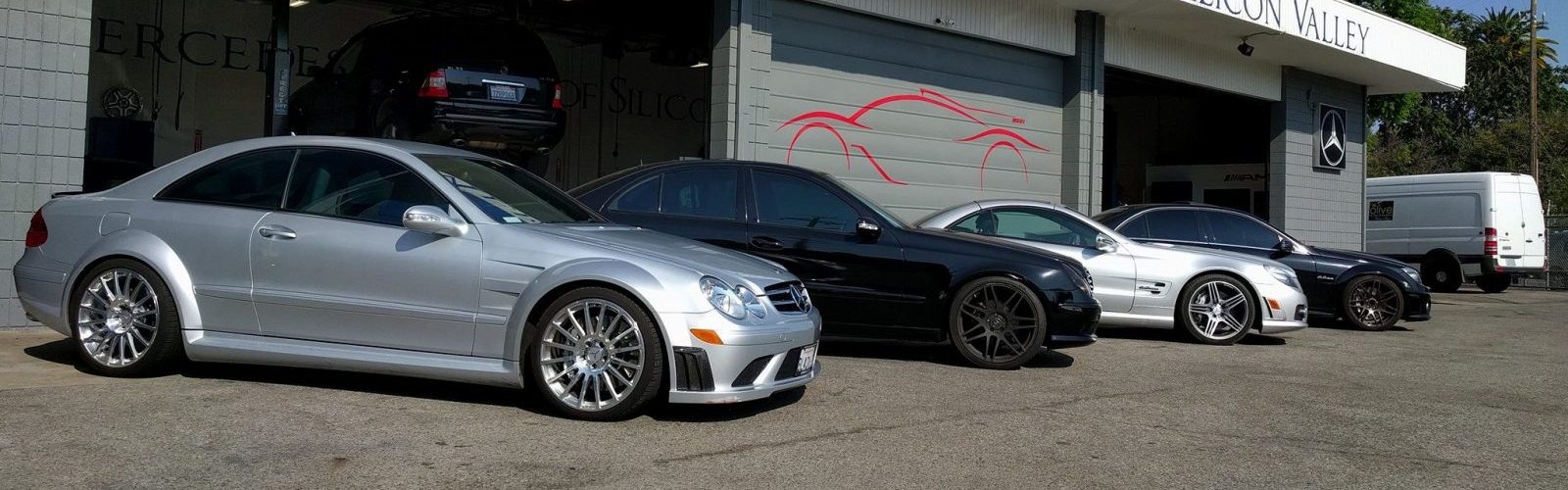
At Mercedes Service of Silicon Valley, the focus is on identifying what is actually needed and explaining why. That can mean confirming a single failed component, recommending related parts that are near the end of their service life, or advising that a minor concern can be monitored rather than repaired immediately. Transparent recommendations matter because not every noise requires a major overhaul, but delaying a genuine safety or air-suspension fault can increase the eventual repair cost.
OEM parts and fluids, or carefully selected OEM-quality components where appropriate, help preserve the fit, durability, and performance expected from the vehicle. Lower-cost parts can be tempting, particularly for bushings, arms, and air-suspension components. The trade-off is often shorter service life, incorrect fitment, added noise, or less consistent ride quality.
Protecting Ride Quality Over the Long Term
There is no single mileage interval for replacing Mercedes suspension components. Driving habits, road quality, climate, vehicle weight, and model design all matter. A commuter vehicle that spends its life on smooth highways may wear differently than an SUV navigating potholes, steep driveways, and frequent passenger or cargo loads.
The practical approach is to include suspension and tire checks during regular service, act on clear changes in ride or handling, and avoid treating tire wear as an isolated issue. Keeping tires properly inflated also reduces stress on chassis components and makes it easier to identify a developing problem before it affects safety or comfort.
Your Mercedes should feel controlled, quiet, and confidence-inspiring every time you drive it. When it no longer does, an early inspection can protect the tires, the chassis, and the driving experience that made you choose the vehicle in the first place.