
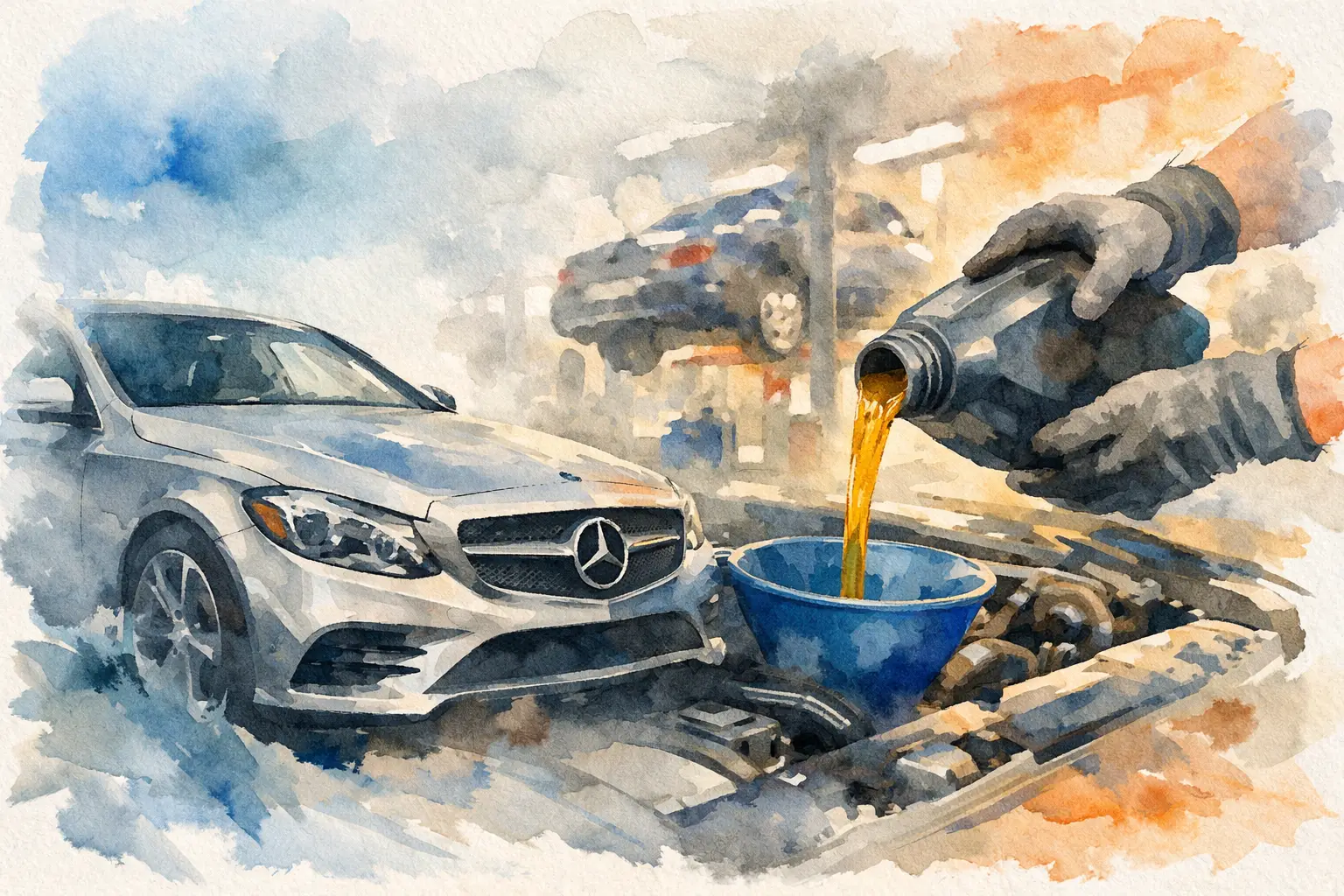
A warning light may get your attention, but the fluids circulating through your Mercedes influence its condition every mile before that light ever appears. Mercedes service with OEM fluids is not simply a premium add-on. It is a practical way to protect the engine, transmission, cooling system, brakes, and drivetrain according to the specifications Mercedes-Benz engineered for your vehicle.
For owners in Silicon Valley, the right fluid service also helps avoid a familiar problem: paying for work that sounds necessary without receiving a clear explanation of what is actually due. A Mercedes specialist should identify the correct factory-approved fluid, inspect the system it serves, and explain the recommendation in plain language.
Why Mercedes Service With OEM Fluids Matters
Mercedes-Benz designs each system around specific fluid properties. Oil must maintain the correct protection at operating temperature while supporting modern emissions equipment. Transmission fluid must work with the exact clutch materials and hydraulic controls inside a particular gearbox. Coolant has to protect mixed-metal cooling components without creating corrosion issues over time.
That is why a bottle labeled with a familiar viscosity or a general claim of compatibility is not always enough. The relevant question is whether the fluid meets the Mercedes-Benz approval specified for your model, engine, transmission, and model year.
OEM fluids are formulated or supplied to meet those factory requirements. In many cases, Mercedes publishes an approval number for the application rather than relying on a broad category such as “synthetic oil” or “universal ATF.” A trained technician checks the applicable specification instead of making assumptions based on what worked in another vehicle.
This matters across the lineup. A commuter-driven C-Class, a family GLS, an AMG model that sees spirited driving, and a Sprinter used for business can all have very different service needs. Even two vehicles with similar engines may use different fluid specifications because of production changes, drivetrain configuration, or updated factory guidance.
Oil Service Is More Than an Oil Change
Engine oil is the fluid most owners think about first, and for good reason. It lubricates moving components, carries heat away from critical areas, helps control deposits, and supports systems such as turbochargers and variable valve timing. On newer Mercedes models, the oil specification can also affect long-term compatibility with emissions-control components.
During a proper Mercedes oil service, the technician should confirm the approved oil specification, use the appropriate filter, inspect for leaks or abnormal wear indicators, and reset the maintenance system correctly. The service interval displayed by the vehicle is useful, but driving conditions still matter. Short trips, extended idling, high heat, heavy traffic, towing, and performance use can all be harder on oil than steady highway driving.
There is a trade-off here. Changing oil far earlier than necessary does not automatically improve reliability, especially if the service is performed without attention to the correct specification. On the other hand, stretching an interval beyond what the vehicle and its operating conditions support can allow oil degradation and contamination to become a concern. The best plan is based on your Mercedes maintenance schedule, vehicle condition, and real driving habits.
OEM Filters Matter Too
Oil quality and filter quality work together. A correct OEM filter is designed to fit the housing, seal properly, and provide the filtration characteristics expected by the engine. Saving a small amount with an unknown filter can introduce avoidable risk, particularly on engines where oil pressure, clean oil flow, and proper sealing are critical.
Transmission Fluid Requires Model-Specific Knowledge
Automatic transmission service is one area where generic fluids can create expensive problems. Mercedes transmissions use precise hydraulic pressure and electronically controlled shift strategies. The fluid must provide the friction characteristics the transmission was designed around.
A transmission that shifts harshly, hesitates, or feels inconsistent does not always need a fluid service. It may have an adaptation issue, software concern, internal fault, or driveline problem. Likewise, a vehicle that feels normal may still be due for service based on age, mileage, or its Mercedes maintenance plan.
The right approach begins with diagnosis and verification. A Mercedes specialist can identify the transmission type, confirm the approved fluid and filter requirements, inspect for leaks, and determine whether service is appropriate. This is more responsible than treating every automatic transmission as though it accepts the same fluid and service procedure.
For vehicles with 4MATIC, transfer case and differential fluids deserve the same attention. These components work under load and rely on the proper lubricants to protect gears, bearings, and clutches where applicable. Their service intervals and fluid requirements are not interchangeable with engine or transmission oil.
Cooling System, Brake Fluid, and Other Critical Fluids
Not every fluid service is driven by mileage alone. Brake fluid, for example, absorbs moisture over time. That moisture can lower the fluid’s boiling point and contribute to corrosion in hydraulic brake components. Because braking is a safety system, following the recommended time-based brake fluid interval is a smart investment even if the vehicle has not accumulated many miles.
Mercedes coolant is also specific for a reason. Cooling systems contain aluminum, seals, water pumps, radiators, and other materials that benefit from the correct corrosion protection. Mixing incompatible coolant types or topping off with an unknown product can compromise the chemistry of the system. If a coolant level is low, the priority is not merely refilling it. The source of the loss should be inspected.
Power steering fluid, hydraulic suspension fluid, washer fluid, and diesel exhaust fluid may also require attention depending on the vehicle. A knowledgeable service visit separates routine maintenance from a meaningful inspection. It avoids both extremes: ignoring a developing issue and recommending a flush simply because a fluid looks dark.
OEM Does Not Mean Guesswork or Unnecessary Service
Quality maintenance should never become a reason to oversell. Some fluids have published replacement intervals, while others are inspected and serviced based on vehicle-specific requirements or repair conditions. A trustworthy shop will explain the difference.
For example, a coolant exchange may be appropriate when the maintenance schedule calls for it, contamination is present, or a cooling-system repair requires it. It is not automatically justified just because the vehicle is in the shop for an oil change. The same principle applies to transmission, differential, and brake fluid services.
At Mercedes Service of Silicon Valley, the goal is to provide factory-level care without the impersonal process or blanket recommendations some owners associate with dealership visits. That means using the correct OEM parts and fluids, applying Mercedes-specific diagnostic knowledge, and being direct about what your vehicle needs now, what can be monitored, and why.
What to Expect From a Proper Fluid Service
A complete service should start with your vehicle’s VIN, mileage, service history, and any concerns you have noticed. From there, the technician can verify factory specifications and assess the relevant system rather than relying on a one-size-fits-all menu.
You should receive a clear explanation of the fluid being used and the reason for the service. If a leak, contamination, fault code, or abnormal condition is found, the recommendation should address the cause rather than only replacing the fluid. Fresh fluid cannot correct a failing seal, a damaged component, or an underlying cooling-system pressure issue.
This process is especially valuable for pre-owned Mercedes vehicles with incomplete records. A careful inspection can establish a sensible maintenance baseline without replacing every fluid at once. Priorities should be based on safety, factory intervals, visible condition, known service history, and the way you use the vehicle.
Protect the Mercedes You Chose
Your Mercedes was built around exact engineering standards, and its fluid services deserve the same level of care. Whether you drive a refined daily commuter, a hard-working Sprinter, or an AMG that gets exercised on weekends, correct OEM fluids and informed recommendations help preserve the driving experience you bought the vehicle for.
When it is time for maintenance, ask which specification your vehicle requires, what the service includes, and whether there is evidence that it is due. Clear answers are a good sign that your Mercedes is being cared for with the attention it deserves.