
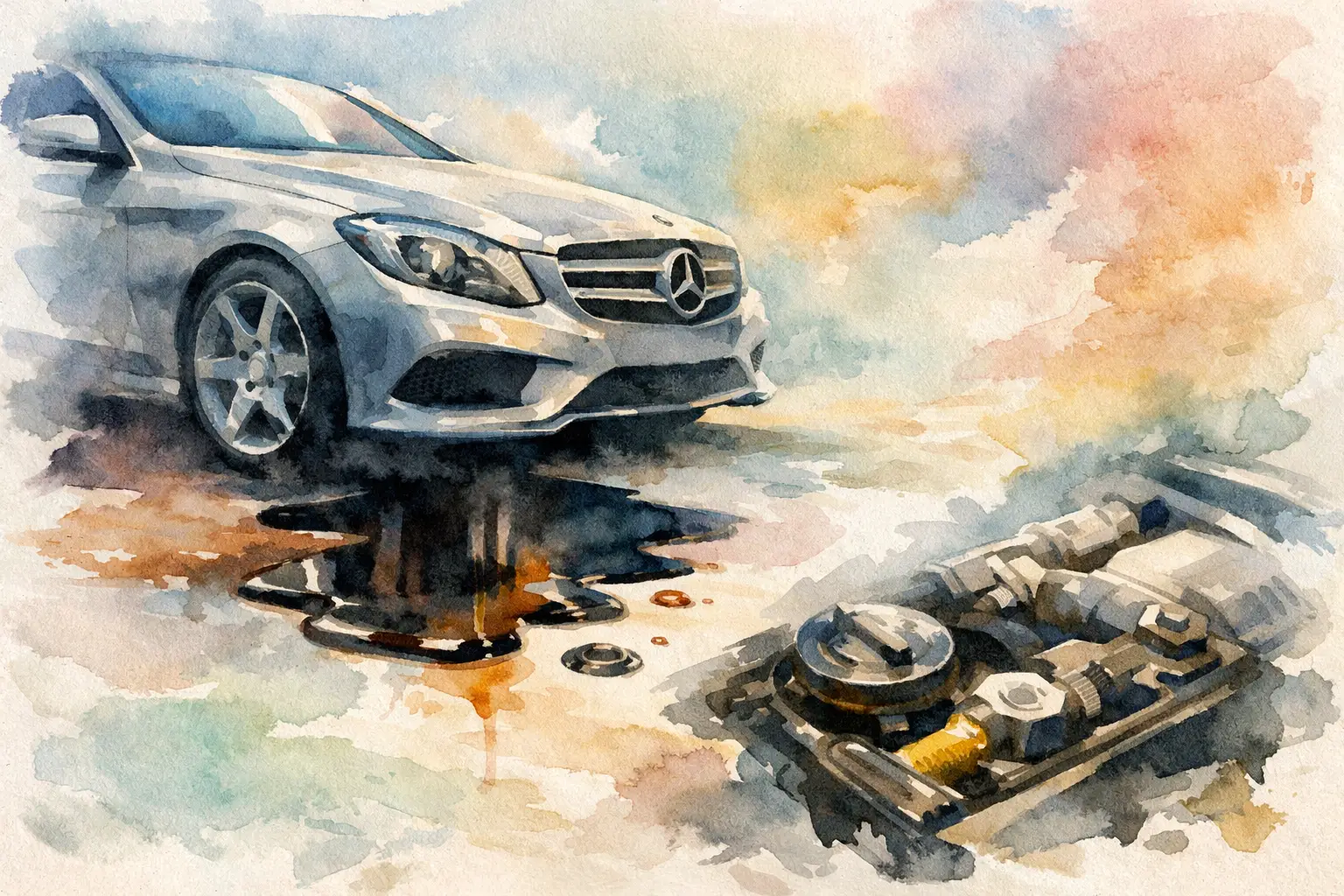
A few drops on the garage floor can look like a small problem, but Mercedes oil leak examples often tell a more specific story. On a Mercedes-Benz, the location of the oil, its smell, and the conditions that trigger it can help narrow the cause before a minor seep becomes a repair that affects belts, wiring, exhaust components, or engine oil level.
For Silicon Valley drivers, oil leaks are especially easy to overlook. A daily commute can hide a leak because airflow spreads oil across the underside of the vehicle, and modern undertrays can hold fluid for some time before it reaches the ground. The right response is not to assume the worst or add oil indefinitely. It is to have the vehicle inspected by a Mercedes specialist who can identify the true source and explain what is urgent, what can be monitored, and what should be repaired soon.
Common Mercedes Oil Leak Examples
Mercedes engines use high-quality gaskets, seals, and crankcase ventilation systems, but heat cycles and mileage eventually affect every rubber and plastic component. The most common leaks are not identical across every model, yet certain patterns appear frequently on C-Class, E-Class, S-Class, GLE, GL, Sprinter, and AMG vehicles.
Valve cover gasket leaks
A valve cover gasket seals the top of the engine where the valve cover meets the cylinder head. As the gasket ages, it can harden and allow oil to seep down the outside of the engine. On V6, V8, and many turbocharged engines, oil may collect around the ignition coils, spark plug wells, or exhaust-side areas of the cylinder head.
Owners may notice a warm oil smell after parking, light smoke from the engine bay, or oil residue near the top of the engine. In some cases, a valve cover leak can contaminate ignition components and contribute to misfires. The repair may be straightforward, but it should include careful inspection of the cover itself, fasteners, PCV-related components, and any oil-soaked wiring or coil boots.
Oil filter housing and oil cooler seal leaks
Oil filter housings and oil cooler assemblies are another frequent source, particularly on engines where the housing sits in the engine valley or near the front of the engine. The sealing rings can flatten over time, allowing oil to leak externally. Depending on the engine design, oil may travel down the block and appear to be coming from the oil pan.
This is why visual inspection alone is not always enough. A proper diagnosis may require cleaning the engine, applying UV dye when appropriate, and inspecting from above and below. Replacing the wrong gasket can waste time and money while the actual leak continues.
Timing cover and front engine cover leaks
Oil around the front of the engine may point to a timing cover, front cover, camshaft seal, or crankshaft seal. These areas are exposed to significant heat and vibration. A front engine oil leak can spread onto accessory belts and pulleys, which may cause belt noise, deterioration, or slippage.
The repair approach depends on the engine and the precise source. A minor exterior seep may be monitored if the oil level remains stable and no components are being damaged. A leak that reaches the belt drive, however, deserves prompt attention. On a Mercedes, protecting the surrounding components is just as important as stopping the visible drip.
Rear main seal leaks
A rear main seal sits between the engine and transmission, sealing the rear of the crankshaft. When it leaks, oil often appears at the bottom of the transmission bell housing. This can be one of the more labor-intensive Mercedes oil leak examples because transmission removal may be needed to access the seal.
Not every wet bell housing confirms a rear main seal failure. Oil from higher on the engine can run down and collect in the same area. Before authorizing a major repair, owners should expect their technician to verify the source and rule out valve cover, vacuum pump, oil separator, or upper engine leaks.
Oil pan gasket and drain plug leaks
An oil pan gasket leak usually leaves oil around the lower edge of the engine. On some Mercedes models, the oil pan design and subframe placement can make gasket replacement more involved than it appears. A damaged pan, stripped drain plug threads, a worn crush washer, or an incorrectly installed oil filter cap seal can also create a leak shortly after an oil service.
This is one reason OEM-quality filters, correct fluids, and proper service procedures matter. An oil change should not create a new problem. If a leak appears soon after service, have it inspected rather than repeatedly tightening the drain plug, which can damage the pan or threads.
Turbocharger oil line leaks
Turbocharged Mercedes engines use pressurized oil feed and return lines to lubricate the turbocharger. Leaks at these connections may leave oil near the turbo, downpipe, or heat shielding. Because these areas run extremely hot, an oil leak here can produce a sharp burning smell or visible smoke.
This is not a situation to ignore. Oil on hot exhaust hardware presents a fire risk, even when the leak seems small. A technician should inspect the oil lines, fittings, turbo seals, and nearby coolant connections to determine whether the leak is external or related to a larger turbocharger concern.
Not Every Fluid Leak Is Engine Oil
Before diagnosing an oil leak, identify the fluid. Fresh engine oil is usually amber to brown, while older oil can be dark brown or black. Transmission fluid may be reddish-brown, though color varies with age and model. Coolant can be blue, pink, green, or clear depending on the approved Mercedes coolant used. Water from air-conditioning condensation is normal and should be clear and odorless.
Engine oil has a distinct petroleum smell and feels slick between gloved fingers. However, fluid color alone is not a dependable diagnostic method. Underbody panels, road grime, and old residue can make several fluids look alike. A trained inspection is the reliable way to determine both the fluid and its source.
When an Oil Leak Needs Immediate Attention
A light seep is not always an emergency. Many higher-mileage Mercedes vehicles develop minor gasket moisture that can be observed during routine service. The decision depends on leak rate, location, oil consumption, and the possibility of damage to other systems.
Schedule service promptly if you smell burning oil, see smoke from the engine bay, find fresh oil on the driveway, or need to add oil between normal service intervals. Stop driving and arrange an inspection if the oil pressure warning appears, the engine oil level is critically low, oil is dripping onto the exhaust, or the leak follows an impact under the vehicle.
Do not confuse the electronic oil-level warning with a reason to simply top off the engine and continue driving for months. The warning is doing its job by telling you the engine needs attention. Continuing to drive with a leak can turn a gasket repair into internal engine wear, catalytic converter contamination, damaged rubber mounts, or an expensive cleaning and repair process.
Why Mercedes-Specific Diagnosis Matters
A Mercedes-Benz is not best served by guesswork or generic leak repairs. Many engines have layered covers, tight packaging, turbocharger plumbing, and underbody shields that make the visible drip far removed from the original failure point. Advanced diagnostics, factory-level repair information, and experience with common Mercedes engine designs make a meaningful difference.
At Mercedes Service of Silicon Valley, our technicians inspect the entire affected area rather than replacing parts based only on appearance. We look for the source, confirm whether oil has damaged nearby components, and recommend OEM-quality parts and fluids where they matter. Just as importantly, we explain the repair priority clearly. Some leaks should be addressed now; others can be watched during scheduled maintenance with a documented baseline.
What Owners Can Do Before the Appointment
Avoid pressure-washing the engine bay immediately before service, as this can remove useful evidence and push water into electrical areas. Instead, take a photo of the parking spot, note where the vehicle was parked, and pay attention to when the smell or smoke occurs. Is it only after a highway drive? Does it appear after an oil change? Is oil accumulating near one wheel or directly under the center of the engine?
Check the engine oil level using the vehicle’s approved electronic measurement procedure and only add the correct oil specification if necessary. Overfilling can create its own problems, including increased crankcase pressure and leaks. If you are unsure what oil your Mercedes requires, it is better to ask than to use a product based only on viscosity printed on the bottle.
A clean, dry Mercedes engine is the goal, but the best repair is not always the biggest one. Accurate diagnosis gives you the confidence to fix the issue that is actually present, protect the vehicle you rely on, and keep small signs of wear from becoming a reason to cut the next drive short.