A Mercedes brake job is not the place for a one-size-fits-all part decision. When Mercedes brake rotor options compared is the question, the right answer depends on your exact model, driving habits, brake system, and expectations for comfort. A rotor that works well on a C-Class commuter may be a poor fit for an AMG sedan, a loaded GLS, or a Sprinter that regularly carries equipment across Silicon Valley.
Rotors do more than provide a surface for brake pads. They absorb and release a tremendous amount of heat, preserve pedal consistency, and work with the vehicle’s ABS, stability control, and brake wear monitoring systems. Selecting the correct quality and design protects the refined braking feel Mercedes-Benz owners expect.
Mercedes Brake Rotor Options Compared by Use
For most Mercedes owners, the decision comes down to OEM-equivalent replacement rotors, genuine Mercedes-Benz rotors, or performance-oriented rotors. Each can be appropriate. The important factor is matching the part to the vehicle rather than choosing based only on the lowest price or the most aggressive appearance.
Genuine Mercedes-Benz Rotors
Genuine Mercedes-Benz rotors are built to the specifications set for a particular chassis, brake package, and axle. They are the most straightforward choice for owners who want their vehicle to retain its original pedal feel, noise characteristics, and braking balance.
This is especially valuable on late-model vehicles with advanced driver-assistance systems, electronic brake functions, and model-specific brake calibrations. Genuine parts also eliminate guesswork over dimensions, ventilation design, hub fitment, and compatibility with factory pads.
For a daily-driven E-Class, GLE, S-Class, or Sprinter, genuine rotors are often the right long-term choice. They deliver predictable service life and preserve the smooth, quiet operation expected from the brand. Their trade-off is cost. They are rarely the least expensive option, but they can offer the best value when correct fitment and refinement are the priorities.
OEM-Equivalent Rotors
OEM-equivalent rotors are made by reputable manufacturers that supply parts designed to meet or closely match factory specifications. This category can provide excellent results when the manufacturer, part number, and application are carefully verified.
A quality OEM-equivalent rotor should have the correct diameter, thickness, cooling vane configuration, hat offset, center bore, and corrosion protection. Those details matter. A rotor can appear to fit a Mercedes while failing to deliver the heat capacity or exact alignment required for its brake system.
For many non-AMG Mercedes models, a properly selected OEM-equivalent rotor is a sensible, cost-conscious solution. It can provide factory-like braking performance without dealership pricing. However, not every aftermarket rotor deserves the OEM-equivalent label. Extremely low-cost parts may use inconsistent castings, inadequate coatings, or machining tolerances that can contribute to noise, vibration, and uneven wear.
Performance Rotors
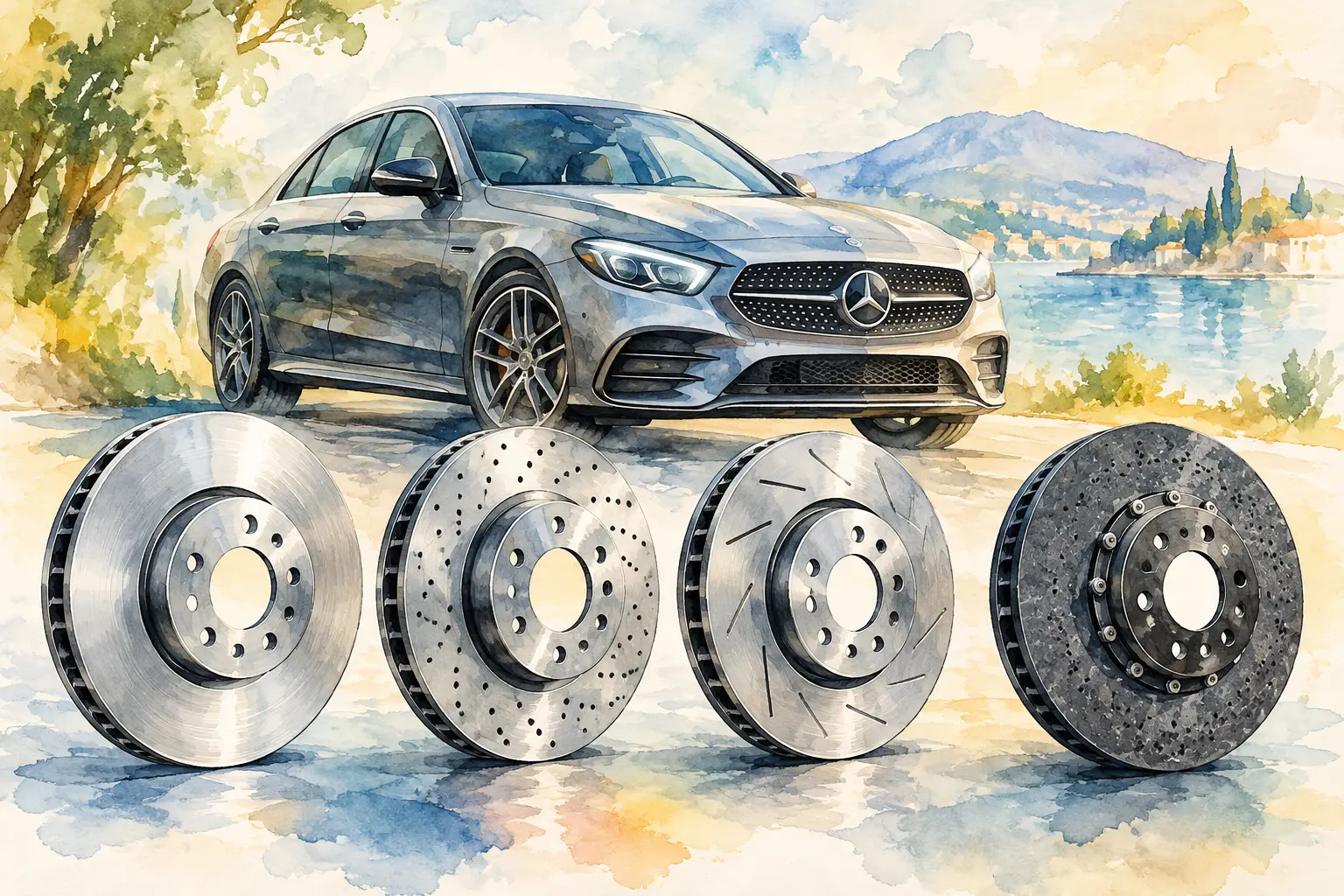
Performance rotors are aimed at drivers who place greater demands on their brakes. They may use higher-carbon cast iron, improved vane designs, slotted friction surfaces, or two-piece construction. The best choice depends on how the car is actually driven.
High-carbon rotors can improve thermal stability and help reduce the tendency toward brake judder under repeated high-temperature use. They are a strong consideration for heavier Mercedes SUVs, vehicles driven in mountain terrain, and AMG models that see spirited street use.
Slotted rotors can help refresh the pad surface and provide more consistent braking during repeated hard stops. They can be useful for track-oriented applications, but they may increase pad wear and create more audible braking noise. For a quiet luxury sedan used primarily in San Jose traffic, slotted rotors are not automatically an upgrade.
Drilled rotors are common on factory Mercedes performance applications and have a distinctive appearance. On a properly engineered original-equipment system, they can perform well. But aftermarket drilled rotors for demanding use require caution. Drilling removes material and can create stress points, particularly when the vehicle is regularly exposed to repeated high heat. For serious track use, a quality plain-faced or slotted rotor is often the more durable option.
Two-piece rotors use a separate friction ring and center hat, often reducing unsprung weight while improving heat management. They can be an excellent solution for certain AMG and performance builds, but they are expensive and unnecessary for most standard Mercedes service needs.
Plain, Drilled, and Slotted Rotor Designs
The rotor face is only one part of brake performance, but it is a frequent source of confusion. Plain rotors offer the largest uninterrupted friction surface and are generally the quietest, longest-lasting design. They are ideal for most daily drivers and work exceptionally well when paired with the correct pads.
Factory-drilled rotors may be appropriate when your Mercedes was engineered with them from the start. Replacing them with the correct original-style design maintains the intended appearance and brake response. Switching a non-drilled system to drilled rotors strictly for appearance rarely improves real-world stopping performance.
Slotted rotors make more sense for enthusiastic drivers who accept added noise and potentially faster pad wear in exchange for consistent feel during repeated hard braking. The key is restraint: performance hardware should solve a real heat-management or driving-demand issue, not create new compromises on a vehicle that spends most of its time commuting.
Rotor Material and Coating Matter More Than Appearance
A rotor’s metallurgy and finish affect how it behaves over thousands of miles. Premium rotors commonly use high-carbon iron formulations that better manage heat cycling and resist distortion. They may cost more initially, but that investment can be worthwhile on larger vehicles and high-output models.
Protective coatings are also practical, not cosmetic. A coated rotor hat and outer edge help resist surface corrosion, which is useful in areas with coastal air, seasonal rain, or vehicles parked outdoors. The coating on the braking surface wears away quickly with normal use, while the protected non-friction areas maintain a cleaner appearance.
No coating, material, or rotor design can compensate for incorrect installation. The hub surface must be cleaned thoroughly, rotor runout must be checked when needed, and wheel bolts must be torqued evenly to Mercedes specifications. Excessive runout or uneven wheel torque can lead to pedal pulsation that is often mistaken for a “warped rotor.”
Why Brake Pads Must Be Chosen With the Rotors
Rotors and pads are a matched system. Installing premium rotors with an unsuitable pad compound can lead to squealing, excess brake dust, poor cold performance, or accelerated wear. Conversely, a high-performance pad may be frustratingly noisy and dusty on a luxury daily driver even if it offers excellent fade resistance.
Most owners are best served by OEM-quality pads matched to OEM or OEM-equivalent rotors. This combination supports smooth engagement, predictable stopping power, and the quiet operation Mercedes-Benz vehicles are known for. Performance pads should be selected when the vehicle’s use justifies them, such as repeated canyon driving, towing, track events, or a tuned AMG with significantly increased power.
Brake wear sensors should also be inspected and replaced when indicated. On many Mercedes models, reusing a triggered or damaged sensor can leave a warning light on after otherwise proper brake service.
Model-Specific Fitment Is Non-Negotiable
Mercedes-Benz uses a wide range of brake configurations, even within the same model line. A C-Class may have different rotor sizes based on engine, drivetrain, year, Sport package, or optional brake system. AMG models can use substantially different calipers, rotor dimensions, and pad shapes than non-AMG versions that look similar from the outside.
The same applies to SUVs and Sprinters. Vehicle weight, wheel size, towing capacity, and commercial use all influence the braking components specified by the factory. Ordering by model name alone is not enough. Accurate selection should be based on the VIN, installed brake option, and direct inspection of the vehicle when necessary.
This is one reason a specialized Mercedes shop adds value beyond simply installing parts. Factory-level diagnostic equipment, Mercedes-specific repair information, and hands-on familiarity with common chassis variations help prevent expensive fitment mistakes.
When Should Rotors Be Replaced?
Rotors should be measured, not judged only by appearance. Mercedes specifies a minimum thickness for each rotor, and that measurement determines whether resurfacing or replacement is appropriate. In many modern applications, replacement is the more dependable option once rotors are worn, heat-checked, heavily grooved, or near their discard specification.
A steering-wheel shake under braking, pedal pulsation, scraping noise, or reduced stopping confidence deserves prompt inspection. Not every vibration comes from the rotors. Tire issues, suspension wear, wheel balance problems, and hub runout can create similar symptoms. A proper evaluation identifies the actual cause before parts are replaced.
At Mercedes Service of Silicon Valley, we recommend brake components based on the vehicle in front of us and the way its owner uses it. That may mean genuine rotors for a well-kept daily driver, high-quality OEM-equivalent parts for a practical repair, or a performance-focused setup for an AMG owner who needs greater heat control.
The best rotor is rarely the flashiest one. It is the one that fits correctly, works with the right pads, and gives you confidence every time traffic tightens, the road drops downhill, or your Mercedes asks more from its brakes.