
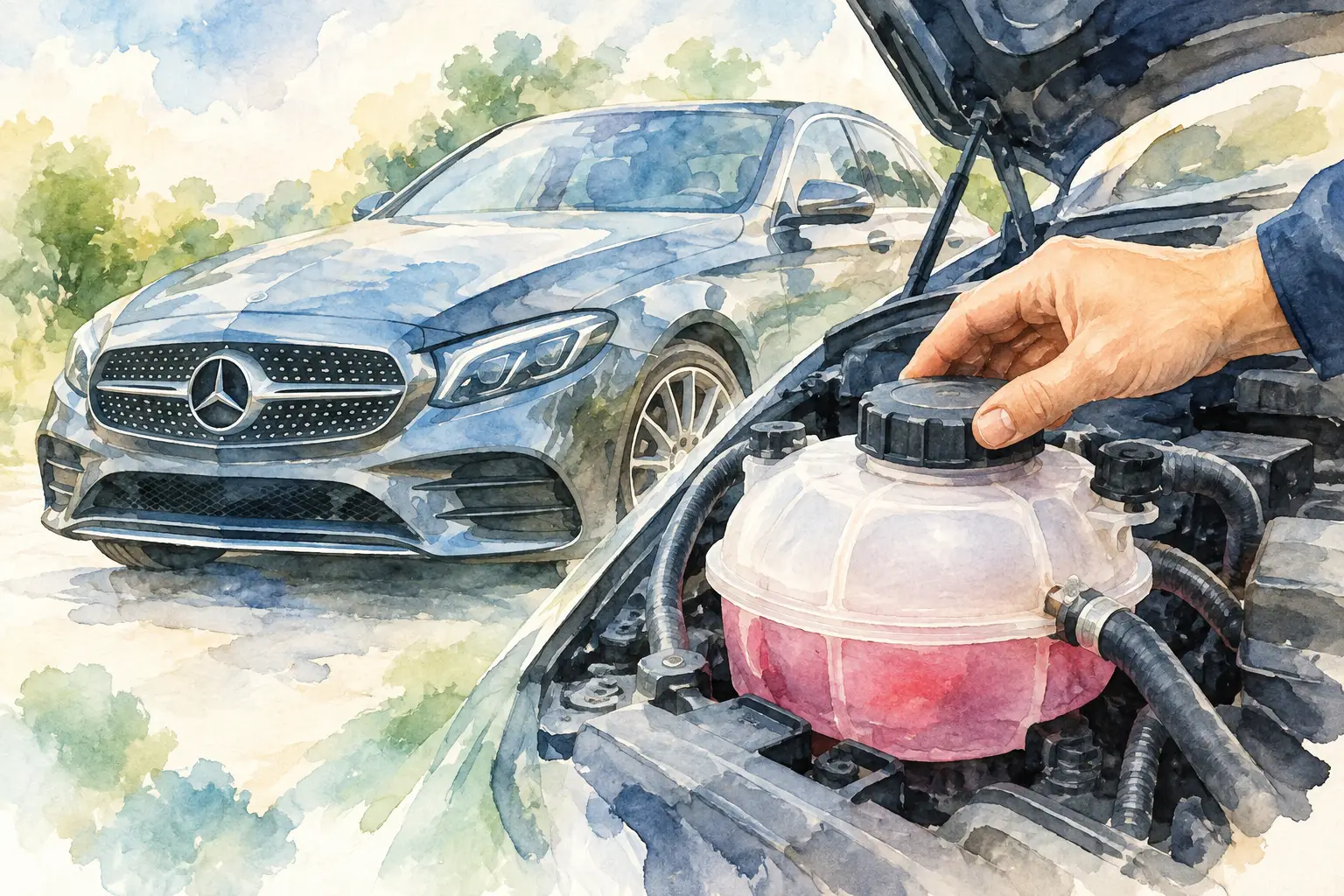
A low coolant warning on a Mercedes-Benz is not a message to ignore until the next oil change. Coolant protects far more than the engine itself – it helps control operating temperature, supports cabin heat, and protects internal passages from corrosion. Knowing how to check Mercedes coolant level correctly can help you catch a small issue before it becomes overheating, a damaged water pump, or a much larger repair.
The key is to check it at the right time, in the right place, and without assuming every Mercedes reservoir works exactly the same. Mercedes-Benz has used different engine layouts, reservoir designs, and coolant specifications across sedans, SUVs, AMG models, and Sprinters.
Check the Coolant Only When the Engine Is Cold
The most important rule is simple: inspect coolant with the engine fully cold. Ideally, let the vehicle sit overnight or for several hours after driving. A hot cooling system is pressurized, and removing the reservoir cap while hot can release extremely hot coolant or steam. That is a real burn risk, not just a precaution printed on the cap.
Checking cold also gives you the most meaningful reading. Coolant expands as it heats up, so a level that looks high after a drive may be perfectly normal. The cold level is the reference point Mercedes intended you to use.
Park on level ground, switch the engine off, and open the hood. If you have recently driven the vehicle, do not loosen the coolant cap to get a quicker answer. Wait until the system has cooled completely.
Finding the Mercedes Coolant Expansion Tank
Most modern Mercedes-Benz vehicles use a translucent plastic coolant expansion tank, often located near the front or side of the engine bay. It will have a pressure cap and typically displays a coolant or temperature warning symbol. On some models, the tank may be partially covered by an engine cover or positioned farther back in the compartment.
Do not confuse the coolant reservoir with the windshield washer fluid tank. Washer-fluid caps are commonly blue and marked with a windshield symbol. The coolant tank has a pressure-rated cap, usually with a warning not to open it when hot.
Depending on the model and model year, the proper level may be indicated by molded MIN and MAX lines on the outside of the tank, a visible internal float, or a level indicator that is easiest to see through the reservoir neck once the cap is removed cold. Your owner’s manual remains the final reference for the exact location and marking style on your Mercedes.
How to Check Mercedes Coolant Level Correctly
With the engine cold and the vehicle on level ground, first look through the side of the translucent tank. If the coolant is clearly between the cold-fill marks, there is usually no reason to remove the cap. A level slightly below MAX is often normal. Filling every tank to the absolute top is not the goal – the cooling system needs room for expansion as temperature rises.
If the markings are difficult to see, use a flashlight rather than guessing. Dirt, heat staining, and aging plastic can make reservoir lines harder to read, especially on older vehicles. Wipe the outside of the tank with a clean cloth before inspecting it.
If your Mercedes uses a float-style indicator and the level cannot be confirmed from outside, slowly remove the cap only after the engine is fully cold. The float or indicator should sit at the specified cold position. Reinstall the cap securely after checking. A cap that is not properly seated can allow pressure loss and contribute to coolant loss over time.
A healthy system should not require regular top-offs. Coolant can drop slightly after certain repairs as trapped air works its way out, but repeated low-level readings deserve professional diagnosis. Mercedes cooling systems are sealed systems. If the level keeps falling, the coolant is going somewhere.
Use the Correct Mercedes-Approved Coolant
Color is not a reliable way to choose coolant. Mercedes-approved coolant is often blue, pink, or another color depending on the formulation and product source, but matching color alone can lead to the wrong decision. What matters is that the coolant meets the Mercedes-Benz specification required for your engine and model year.
The correct specification may vary between vehicles. Many Mercedes models use coolant meeting an MB approval such as 325.0 or a related specification, but owners should not treat one number as universal across every Mercedes-Benz. Check your owner’s manual, service records, or ask a Mercedes specialist to verify the proper OEM fluid.
Mixing incompatible coolants can reduce corrosion protection, create deposits, or compromise the additives that protect aluminum components, seals, and the water pump. If you need a small emergency top-off and the exact approved premixed coolant is unavailable, distilled water is generally safer than mixing in an unknown universal coolant. That is a temporary measure, not a substitute for correcting the mixture and finding out why the level was low.
Avoid tap water. Mineral content can leave scale inside the cooling system, particularly in a vehicle designed with tight cooling passages and sophisticated temperature management.
What a Low Coolant Level Can Mean
A low coolant level does not automatically mean a major engine problem. It can be caused by a minor seep at a hose connection, an aging reservoir cap, or a previous repair that was not fully topped off. Still, the cause matters, and early diagnosis is less expensive than waiting for an overheating event.
Common areas worth inspecting include the reservoir and cap, visible hoses and clamps, the radiator, water pump area, thermostat housing, and the ground beneath the parked vehicle. Look for dried white, pink, or blue residue, depending on the coolant used. A sweet odor after driving or moisture around cooling-system connections can also point to a leak.
Some leaks appear only when the engine is hot and the system is pressurized. Others are too small to leave a noticeable puddle. That is why a visual inspection is useful but not always conclusive. A Mercedes-specific pressure test and proper diagnostic inspection can identify leaks that a driveway check will miss.
On certain Mercedes engines, coolant loss may also be associated with components hidden beneath intake plumbing, around turbocharger coolant circuits, or within the engine’s valley. Those cases require experience with the specific engine family, not guesswork or stop-leak products.
Do Not Drive Through These Warning Signs
If the coolant warning appears, stop as soon as it is safe and assess the situation. Do not continue driving simply because the gauge has not reached the red zone. Modern Mercedes-Benz vehicles can react quickly to temperature changes, and the dashboard may limit power or display multiple warnings when the engine is already under stress.
Turn the engine off immediately if you see steam, smell strong coolant odor, notice an active leak, or receive an overheating message. Do not open the cap. Arrange for an inspection after the vehicle has cooled, and consider towing if the warning was accompanied by high temperature or visible coolant loss.
A low-coolant warning with a normal temperature reading is still worth addressing promptly. The sensor may be catching a low level before the engine overheats, which is exactly the warning you want to act on early.
When a Top-Off Is Reasonable and When It Is Not
A one-time small top-off can be reasonable after confirming the correct fluid, especially if the level is just below the cold minimum and there are no warning lights, leaks, or temperature concerns. Add coolant slowly and stop at the appropriate cold mark. Do not overfill the tank.
If you need to add more than a small amount, the level drops again, or the coolant looks rusty, oily, cloudy, or contaminated, schedule service instead of continuing to refill it. Oil in coolant, coolant in engine oil, or heavy contamination can indicate a problem that needs immediate attention.
At Mercedes Service of Silicon Valley, our technicians inspect the complete cooling system with Mercedes-specific diagnostic equipment and OEM-quality fluids. The goal is not to sell unnecessary repairs. It is to identify the actual source of coolant loss and help protect the engine, heating system, and long-term reliability of your vehicle.
A quick cold-engine check takes only a few minutes, but it gives you valuable information about your Mercedes. Make it part of your regular under-hood routine, and treat any repeated change in coolant level as the early warning it is.