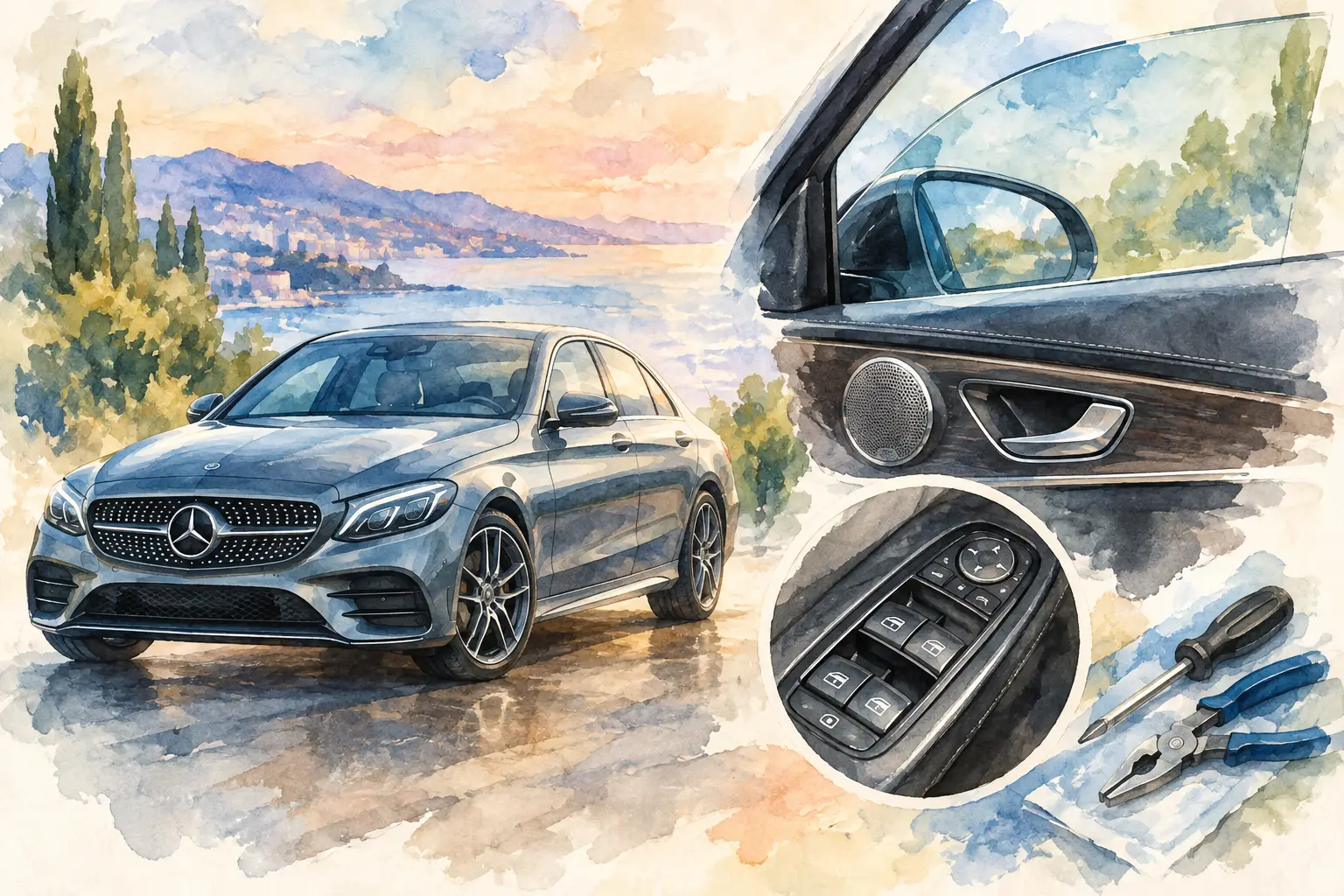
A Mercedes window that slows down, drops into the door, or refuses to move is more than an inconvenience at a drive-through or parking garage. It can leave the cabin exposed to weather, create a security concern, and point to a component that needs attention before it causes further damage. Understanding why Mercedes windows malfunction starts with recognizing that the window system is a coordinated mix of mechanical parts, electric motors, switches, wiring, and vehicle control modules.
Mercedes-Benz window systems are engineered for smooth, quiet operation and features such as one-touch opening, pinch protection, and convenience closing. Those features add comfort, but they also mean the cause is not always as simple as a bad motor. A proper diagnosis protects owners from replacing parts that are not actually at fault.
Why Mercedes Windows Malfunction: The Common Causes
The most frequent failure is the window regulator. This assembly guides the glass up and down using cables, pulleys, tracks, and a carrier that supports the window. Many Mercedes models use a cable-driven regulator. Over time, its cables can fray, stretch, bind, or come off the spool. Plastic guides can also wear or crack, particularly after years of repeated operation and exposure to heat.
A failed regulator often creates a recognizable symptom: the motor can still be heard running, but the glass does not move correctly. The window may tilt forward or backward, move only partway, or suddenly fall into the door. Continuing to operate it can scratch the glass, damage the window tint, or place additional strain on the motor.
The window motor is another possible source of trouble. Motors wear internally, and a weak motor may move the glass slowly or stop after a few seconds. However, a slow window does not automatically mean the motor has failed. A binding regulator, dry or dirty window channels, or a misaligned piece of glass can make a healthy motor work too hard. Replacing a motor without inspecting the regulator and glass movement can lead to an unnecessary repair.
Switches, Door Modules, and Electrical Faults
If one window will not respond from its own door switch but works from the driver’s master switch, the individual switch may be the issue. If it works from neither location, the concern may be farther into the system. Mercedes vehicles commonly use door control modules that communicate with the vehicle’s network, so a switch command may pass through more than one electronic component before the motor receives power.
A failed door module, damaged wiring inside the door, a poor electrical connection, or corrosion at a connector can interrupt this communication. Wiring problems are especially worth considering on older vehicles because the harness flexes each time the door opens and closes. A break may be hidden inside insulation and only cause an intermittent failure when the door is positioned a certain way.
On some models, a blown fuse is possible, but it is rarely the whole story. Fuses generally fail because of excessive current or a short circuit. Installing a new fuse without finding out why the original one failed can result in the same problem returning immediately.
Window Initialization Can Cause One-Touch Problems
If the window moves normally while the switch is held but no longer operates with one touch, the system may have lost its initialization. This can occur after a weak or disconnected battery, battery replacement, certain electrical repairs, or an interruption in window operation.
Initialization allows the vehicle to learn the upper and lower limits of the glass travel. It is essential for one-touch operation and the anti-pinch safety function. The exact procedure varies by model, but it generally involves fully closing the window and continuing to hold the switch in the closed position for several seconds. Some vehicles require an additional open-and-close cycle.
This is one area where the right procedure matters. If the glass is binding, crooked, or encountering resistance, forcing repeated initialization attempts is not a fix. The anti-pinch system may reverse the window because it is correctly detecting excess resistance. The root cause could still be a regulator, track, seal, or alignment problem.
When Window Glass and Seals Are the Real Problem
Mercedes window glass must travel through channels and seals with very precise alignment. Dirt, hardened rubber, damaged felt guides, and debris inside the window channel can increase friction. Silicon Valley’s dry summers, road dust, and long periods of sun exposure can gradually affect rubber components, especially on vehicles that spend much of their time outdoors.
A window that drags, makes a scraping sound, or reverses before reaching the top may have excessive resistance in its path. Owners sometimes apply household lubricants to the channel in an effort to free it up. That can attract dirt, stain the glass, affect trim materials, or make the issue harder to diagnose. The correct approach depends on the condition of the seals, guides, regulator, and glass alignment.
Previous bodywork can also matter. If a door has been repaired after an accident or a window was previously replaced, slight alignment changes may affect how the glass sits in the frame. The concern may not appear immediately. It can become noticeable as the regulator and guides wear over time.
Symptoms That Help Narrow Down the Repair
The pattern of the failure provides useful information. A clicking or grinding noise inside the door often suggests regulator cable or pulley damage. A silent window with no movement may indicate a switch, electrical supply, motor, module, or wiring concern. A window that moves only when the door is partly open can point toward a harness issue in the door jamb.
If several windows stop working at once, the diagnosis changes. A shared fuse, vehicle battery condition, master switch, control module issue, or communication fault becomes more likely than several regulators failing on the same day. Mercedes electrical systems should be checked with brand-capable diagnostic equipment rather than assumptions based on a single symptom.
Watch for related signs as well. A door that will not lock, an inoperative mirror, warning messages, interior lighting irregularities, or intermittent keyless-entry behavior may indicate that the problem extends beyond the window assembly. Those details help a Mercedes-trained technician test the complete system efficiently.
Why Professional Mercedes Diagnostics Matter
Window repairs can look straightforward from the outside, but door panels contain trim clips, vapor barriers, side-airbag-related components on some vehicles, speakers, wiring, and delicate finishes. Incorrect panel removal can create rattles, broken clips, water leaks, or damage that was not present before the repair.
More importantly, replacing a regulator or motor is only the right repair after confirming the fault. A thorough inspection includes verifying switch operation, checking power and ground at the motor, inspecting the regulator and glass movement, reviewing fault codes in relevant modules, and confirming initialization after repairs are complete. OEM-quality parts also matter because the regulator must support the glass accurately through thousands of cycles.
At Mercedes Service of Silicon Valley, our technicians use Mercedes-specific diagnostic equipment and hands-on experience to identify whether the problem is mechanical, electrical, or calibration-related. That approach is designed to give owners a clear recommendation based on what the vehicle needs, not a guess based on the most common failed part.
What to Do When a Mercedes Window Stops Working
Avoid repeatedly pressing the switch if the glass is crooked, grinding, or stuck halfway. The added load can damage the regulator further or overheat the motor. If the window is open and weather is approaching, protect the interior as best as possible and arrange service promptly. Do not force the glass upward by hand unless a qualified technician has advised a safe temporary method, as loose glass can shift unexpectedly.
If the window simply lost one-touch operation after a battery event and otherwise moves smoothly, the owner’s manual procedure may restore it. But if initialization fails, the window reverses, moves unevenly, or makes noise, the vehicle needs an inspection. Addressing the issue early is usually less disruptive than waiting for the glass to drop into the door when you need the vehicle most.
A properly operating window is part of the comfort, safety, and refinement Mercedes owners expect. When yours starts acting differently, treat that change as useful information and have the system checked before a minor symptom becomes an inconvenient failure.