
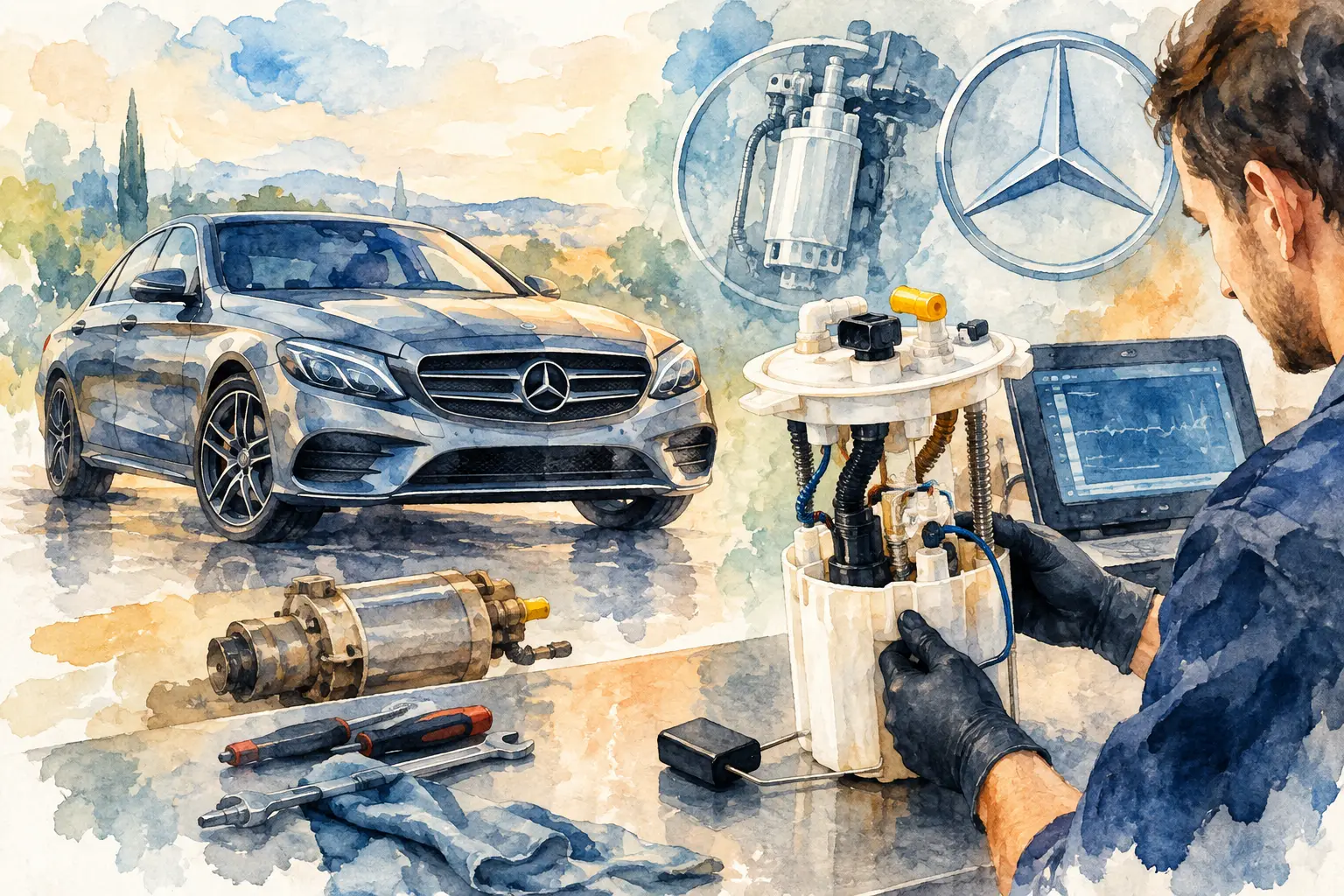
A Mercedes that cranks longer than usual, hesitates while merging onto Highway 101, or loses power under load may have a fuel-delivery problem. This Mercedes fuel pump repair example shows why replacing a pump based on symptoms alone is rarely the right first move. On a modern Mercedes-Benz, the correct repair begins by proving where fuel pressure, volume, or electrical control is falling short.
For Silicon Valley drivers, this matters because fuel-system faults can feel intermittent at first. A vehicle may run normally on a short trip, then struggle after sitting in traffic, climbing a grade, or accelerating with a full passenger load. Careful diagnosis protects the vehicle, prevents unnecessary parts replacement, and gets the repair right the first time.
The Customer Concern: Hesitation and Extended Cranking
Consider a representative late-model Mercedes-Benz SUV that arrives with two complaints: extended crank time after an overnight sit and occasional hesitation during harder acceleration. The check-engine light has appeared once but is not currently illuminated. The owner is understandably concerned about a fuel pump, especially because the symptoms seem more noticeable when the fuel tank is below one-quarter full.
Those symptoms can point toward a weak in-tank fuel pump, but they are not exclusive to it. A restricted fuel filter, failing fuel-pump control module, wiring resistance, a weak battery, a leaking injector, an EVAP issue, or a high-pressure fuel-system fault can create similar drivability concerns. Mercedes models use different fuel-system designs across generations and engine families, so a familiar symptom does not justify a one-size-fits-all repair.
The first job is to document the complaint and establish whether the issue is low-pressure supply, high-pressure delivery, electrical control, or something outside the fuel system entirely.
Mercedes Fuel Pump Repair Example: The Diagnostic Process
A qualified Mercedes technician starts with a full vehicle scan using Mercedes-capable diagnostic equipment. Stored, pending, and history faults all matter. Codes related to fuel pressure, mixture adaptation, fuel-pump actuation, crankshaft speed, or communication with a fuel-pump control unit can shape the next test, but codes are never the whole diagnosis.
Live data is then reviewed during key-on, cranking, idle, and, when appropriate, a controlled road test. Depending on the vehicle, the technician may compare requested fuel pressure with actual pressure, monitor low-pressure pump duty cycle, check battery voltage under load, and observe fuel trim behavior. A pump can make noise and still fail to deliver adequate volume when the engine needs it most.
In this example, the scan data shows an occasional low-pressure supply deviation during harder acceleration. At idle, pressure appears acceptable. That is a critical distinction. An idle-only check could easily lead someone to declare the pump healthy, even though the concern occurs under load.
Separating the Pump From the Electrical System
Before authorizing a fuel-pump replacement, the electrical side must be tested. The technician checks power, ground integrity, connector condition, and voltage drop at the pump circuit. A corroded connection or poor ground can starve an otherwise healthy pump of voltage. Replacing the pump without correcting that underlying issue would produce a disappointing and expensive repeat visit.
The fuel-pump control module also deserves attention on many Mercedes-Benz applications. These modules regulate pump operation based on engine demand. If the module is not commanding the correct output, the pump may appear weak even though the mechanical pump itself is not the root cause.
In our representative case, voltage and ground tests remain within specification, and the control module is commanding the pump correctly. The pressure drop is verified during a load condition, supporting a low-pressure fuel-supply fault rather than a control issue.
Confirming Fuel Volume and Pressure Retention
Pressure is only part of the picture. A pump may briefly produce a reasonable pressure number while failing to move enough fuel volume. Depending on the model and manufacturer procedure, testing may include a fuel-volume measurement or a controlled evaluation of pressure behavior under commanded demand.
The technician also considers pressure retention after shutdown. A rapid loss of pressure can be related to a check valve in the pump assembly, an injector concern, or another leak path. That test prevents the shop from treating extended cranking as a pump problem when the evidence points elsewhere.
Here, the pump cannot consistently maintain the required supply under load, and the evidence supports internal wear in the in-tank pump assembly. The recommended repair is not based on a guess, a noise from the fuel tank, or a generic trouble code. It is based on repeatable test results.
The Repair: Correct Parts and Careful Installation
On many Mercedes-Benz vehicles, the fuel pump is located inside the fuel tank and is accessed through a service opening beneath the rear seat or cargo-area flooring. Other models may require a different procedure. Fuel level, tank configuration, and whether the vehicle has one or multiple sending units can affect the labor involved.
Once the repair is approved, the technician follows the appropriate safety procedures for relieving fuel pressure, disconnecting electrical components, and handling gasoline vapors. The tank area is cleaned before opening it. This simple step matters because debris that falls into the tank can contaminate the new component or contribute to future fuel-system problems.
The old pump assembly is removed and inspected. In some cases, the condition of the tank, electrical connector, or fuel sender offers additional clues. If contamination or damaged wiring is found, that must be addressed along with the pump. Installing a new pump into a compromised system is not a complete repair.
For a Mercedes, component quality is especially important. OEM or OEM-quality parts are selected based on the specific vehicle identification number and fuel-system configuration. A lower-cost universal or poorly matched pump may fit physically but deliver the wrong pressure, operate noisily, trigger fault codes, or have a short service life. Saving money on the part can cost more if the vehicle returns with the same complaint.
The new assembly is installed with the correct seal and locking procedure. The connector is secured, the access area is reassembled, and the fuel system is primed according to the vehicle’s procedure. If required, adaptations or fault memory are addressed with diagnostic equipment rather than simply clearing codes and hoping they stay gone.
Verification Is Part of the Repair
A proper Mercedes fuel pump repair does not end when the engine starts. The technician verifies that the vehicle starts cleanly, that fuel-pressure readings respond correctly, and that no leaks are present around the repaired area. A road test under the conditions that triggered the original complaint is often necessary, particularly when hesitation occurred only during acceleration or higher engine load.
In this example, the SUV starts promptly after sitting, maintains stable low-pressure fuel delivery during acceleration, and no longer records the fuel-supply deviation. The final scan confirms that no related faults return. Just as important, the owner receives a clear explanation of what failed, what was tested, and why the repair recommendation was appropriate.
What Mercedes Owners Should Watch For
Fuel-pump problems do not always create a dramatic no-start condition. Early warning signs can include a longer crank time, hesitation under acceleration, surging, reduced power, stalling, a whining sound from the tank area, or a check-engine light. Some issues become more apparent with low fuel because the pump relies on fuel for cooling and consistent pickup.
Still, those signs do not automatically mean the pump has failed. Modern Mercedes-Benz vehicles are complex, and several systems can imitate a fuel-delivery problem. Avoid continuing to drive aggressively if the engine is stumbling or losing power, particularly if a warning light is flashing. Misfires and lean-running conditions can create additional problems that are more costly than the original repair.
At Mercedes Service of Silicon Valley, our approach is to diagnose the complete system before recommending parts. That means factory-level diagnostic capability, Mercedes-trained experience, and a straightforward discussion of what the vehicle needs now versus what can be monitored.
If your Mercedes is taking longer to start or feels inconsistent when you ask for power, schedule an inspection before a small drivability concern becomes an unexpected no-start. A measured diagnosis gives you a clear repair path and helps preserve the performance and dependability you expect from your Mercedes-Benz.